
Data migration: Comparing rule-based and AI-assisted approaches
Introducing a new information system—whether a CCMS, knowledge platform, customer portal, or AI-powered chatbot—rarely means starting from scratch. Most companies already have large volumes of existing content spread across different systems and formats that must be prepared for use in the new system.
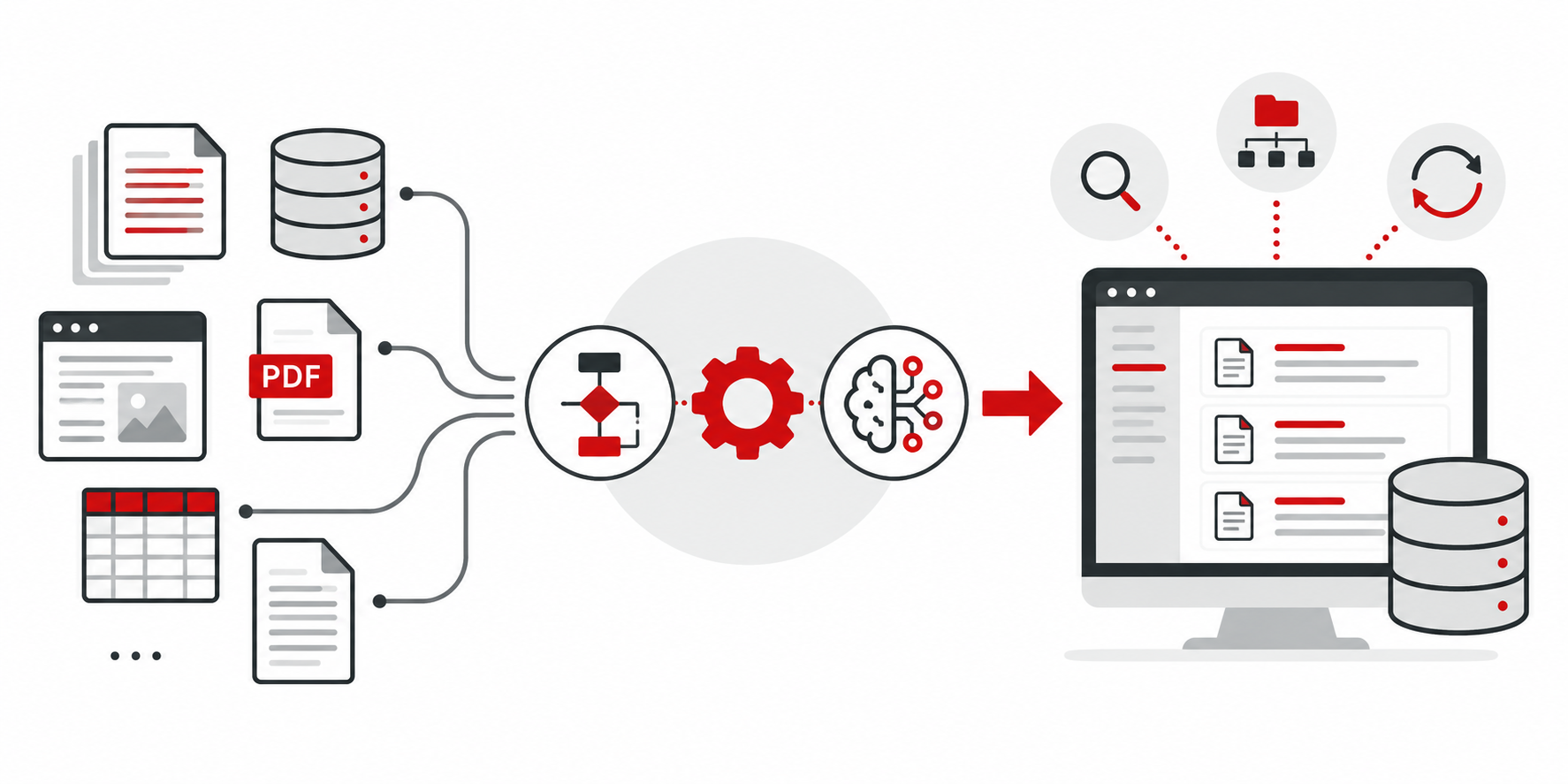
To realize the full benefits of a new information system, this existing content needs to be analyzed, cleaned up, structured, and transferred to the new environment as part of a data migration. This process plays a crucial role in ensuring that information remains findable, reusable, and accessible to modern information systems over the long term.
But data migration involves more than simply transferring data. The key questions are which information will be needed in the future, how it should be structured, and which content should be migrated in the first place.
Common challenges with existing content
Many companies have accumulated content over years or even decades. Different systems, projects, and organizational responsibilities have resulted in information being stored in various formats and structures, often without a consistent approach to organization. Common challenges include:
- Different document formats
- Inconsistent structures
- Missing or incomplete metadata
- Duplicate and redundant content
- Inconsistent terminology
- Outdated content
- Varying quality standards
- Missing information models
The larger and more complex a company's information landscape, the more important it is to conduct a thorough analysis before migration begins.
The first step is therefore to identify and assess the existing content. Only once its quality, structure, and potential for reuse are understood can companies decide which information to migrate, improve, or archive.
Companies often underestimate the effort involved in analyzing, cleaning up, and structuring existing content. A comprehensive assessment provides the foundation for a successful data migration.
New information systems need a well-planned data migration
Many migration projects are initiated as part of implementing new information systems, such as a component content management system (CCMS), knowledge platform, customer portal, or AI application.
Regardless of the target system, existing information must be analyzed, cleaned up, structured, and prepared for future use. Content from Word documents, PDF files, legacy systems, or file repositories is transferred into a structured target architecture. At the same time, the migrated content must support new requirements such as content reuse, variant management, automated publishing, and AI applications.
Many companies initially focus on selecting and implementing their new information system while underestimating the effort required to migrate existing content.
However, transferring content without analyzing it first often means carrying the same problems over to a new technical platform. Migration should therefore be considered early in the overall strategy, rather than only after the system has been selected.
Typical questions include:
- Which content should be migrated, and which should be cleaned up or archived?
- How can existing documents be broken down into reusable modules?
- What metadata will be needed in the future?
- Which target structure will best support future processes?
The answers to these questions are critical to the success of a migration project.
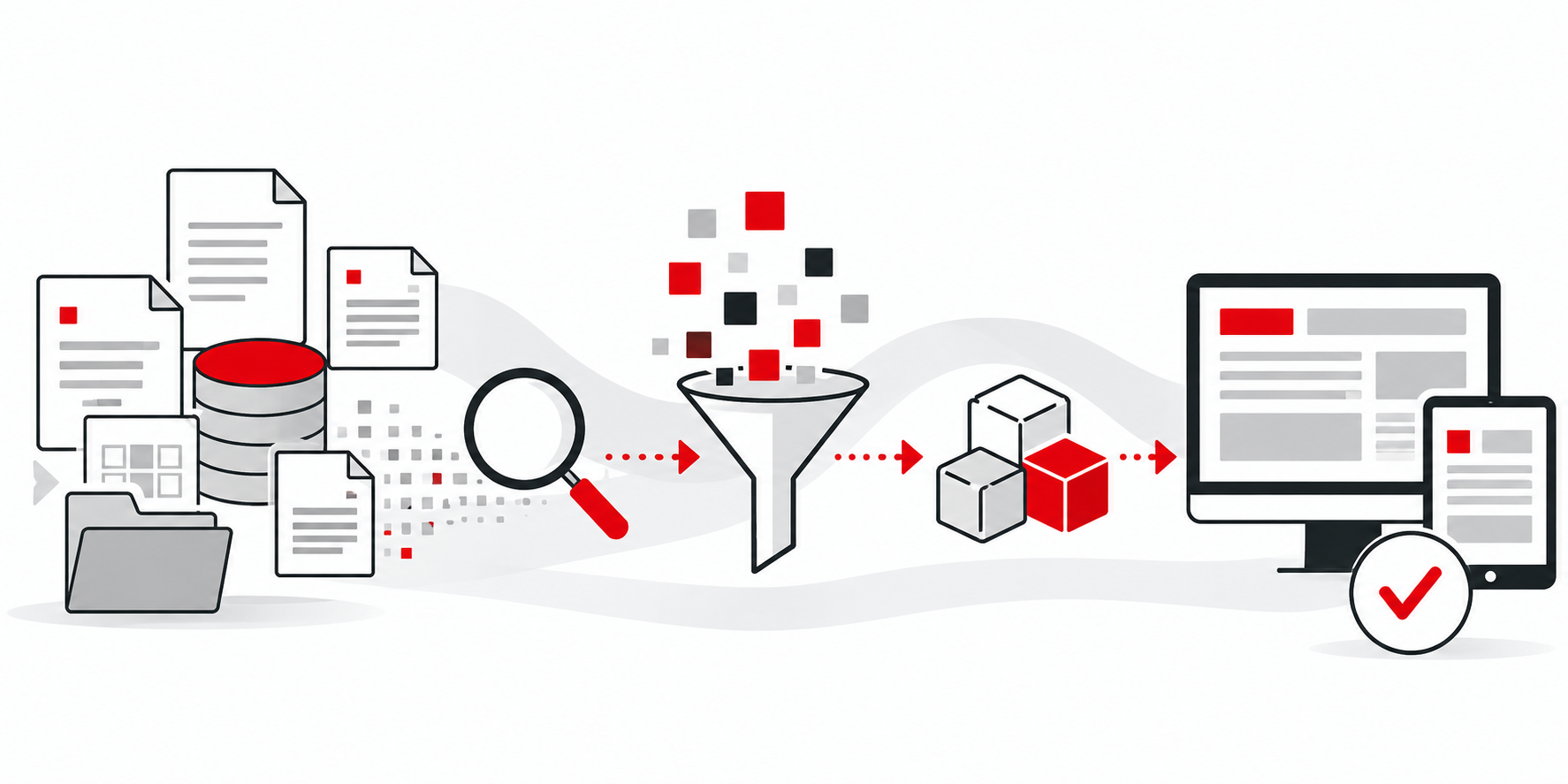
Rule-based vs. AI-assisted migration
How can companies migrate existing information to new systems efficiently, transparently, and in a way that supports future requirements? Both traditional rule-based methods and modern AI-assisted approaches are available. We explore when each approach makes sense.
Rule-based migration: What it can do
This traditional approach to data migration relies on predefined rules and transformation logic. These rules specify exactly how information is transferred from the source system to the target structure.
Typical use cases include:
- Metadata mapping
- Transformation of document structures
- File format conversion, such as Word to XML
- XML structure transformation
- Assignment of categories and classifications
The main advantage of rule-based methods is their transparency. When rules are documented and processing steps are logged, results can be traced and verified. Given the same input, unchanged rules, and an identical processing environment, the results are consistent.
Rule-based migration is particularly suitable when:
- Data is already structured
- Source and target structures are known and clearly defined
- Clear processing rules can be established
- Strict quality or compliance requirements call for documented and controlled processing
- Large volumes of data need to be processed consistently
Limitations of rule-based approaches
Rule-based methods can also be used to check incomplete or inconsistent data. For example, scripts can identify missing mandatory metadata, invalid values, and exact duplicates.
However, the process becomes more complex when assessments cannot be based on clearly defined characteristics. Examples include determining:
- Which documents are related in terms of content, even when they use different terminology
- Which information is no longer factually accurate or up to date
- Whether existing metadata is accurate and plausible in context
- Which content expresses the same meaning in different words
- Which categories would be appropriate based on the subject matter
Defining suitable rules can become particularly time-consuming when migrating technical documentation or carrying out large-scale content migrations. The more inconsistent the source data, the harder it becomes to rely exclusively on rule-based methods.
AI-assisted methods: How they can help
AI models can identify linguistic patterns and semantic similarities, extract information, and suggest classifications. How reliable the results are depends on factors such as the AI method used, the source data, and the domain-specific requirements.
AI can support tasks such as:
- Automatic document classification
- Identifying similar content and potential duplicates
- Generating metadata suggestions
- Detecting potential quality issues and content inconsistencies
- Analyzing topics and content
- Extracting relevant information
- Rewriting and restructuring content
When does AI-assisted data migration make sense?
Not every migration requires artificial intelligence. AI-assisted data migration is particularly useful when:
- Large volumes of unstructured data are involved
- Documents need to be analyzed before migration
- Metadata is missing and needs to be generated or suggested automatically
- Content needs to be reclassified based on its subject matter and meaning
- Knowledge repositories are being prepared for search systems or chatbots
- Existing content needs to be checked for potential errors, duplicates, or inconsistencies
However, AI is no substitute for a migration strategy. Categories, metadata fields, permitted values, and validation rules must be defined to ensure that information can be transferred into the intended target structure.
AI-generated results must be reviewed by subject-matter experts and integrated into the target architecture. Generative AI models can produce information that sounds plausible but is incorrect. AI alone therefore cannot determine whether content is technically accurate or outdated. This requires reliable sources and subject-matter approval.
AI can be particularly valuable in the early stages of a project, when companies first need to gain an overview of large information repositories that have grown over time. A pilot test with a representative sample of existing content can show how well the chosen method performs and whether the time saved justifies the effort required for setup, validation, and post-processing.
AI can also help rewrite or restructure content to fit new information architectures after the initial migration to the target format. For example, it can extract individual procedural steps from a block of text and present them separately.
Costs are another factor to consider. Processing large volumes of documentation with AI can generate significant token usage and associated expenses.
Comparing rule-based and AI-assisted data migration
| Criterion | Rule-based migration | AI-assisted migration |
|---|---|---|
| How it works | Processing based on predefined rules | Analysis and classification using AI models |
| Traceability | High when rules are documented | Depends on the method used |
| Reproducibility | High: Identical inputs and rules produce identical results under the same processing conditions | Depends on the model and configuration; results may vary |
| Structured data | Very well suited | Well suited |
| Unstructured data | Possible when recognizable patterns exist; more complex with heterogeneous content | Can support analysis and structuring; requires expert review |
| Metadata enrichment | Can be automated using predefined rules and available sources | AI-assisted identification and assignment; target structures, permitted values, and validation rules must be defined |
| Identifying relationships | Based on predefined characteristics and relationships | Can identify semantic similarities and potential relationships |
| Effort required for heterogeneous data | Often high | Potentially lower; setup, validation, and post-processing effort must be considered |
| Typical applications | XML migrations, CCMS projects, file format conversions | Analysis, classification, content cleanup, and structuring |
Why hybrid approaches are often the best solution
When dealing with inconsistent or heterogeneous data, it can make sense to combine rule-based and AI-assisted methods. Clearly structured source data with consistent formats and unambiguous mapping rules can often be migrated entirely using rule-based methods. However, these methods reach their limits when information is unstructured or inconsistently organized.
The benefits of hybrid approaches become particularly apparent when companies migrate technical documentation or prepare extensive knowledge repositories for new search systems, customer portals, or AI applications. These projects often involve consolidating documents from different sources, restructuring content, and adding missing metadata.
Rule-based and AI-assisted methods do not have to be applied separately to different source formats. Instead, they can be combined at different processing stages within the same migration workflow.
The two approaches complement each other:
- AI helps analyze, assess, and structure existing content.
- Rule-based methods validate formal requirements and transfer approved content to the target system in a controlled and reproducible way.
- Quality assurance covers both approaches, verifying that the results are technically accurate and meet the requirements of the target system.
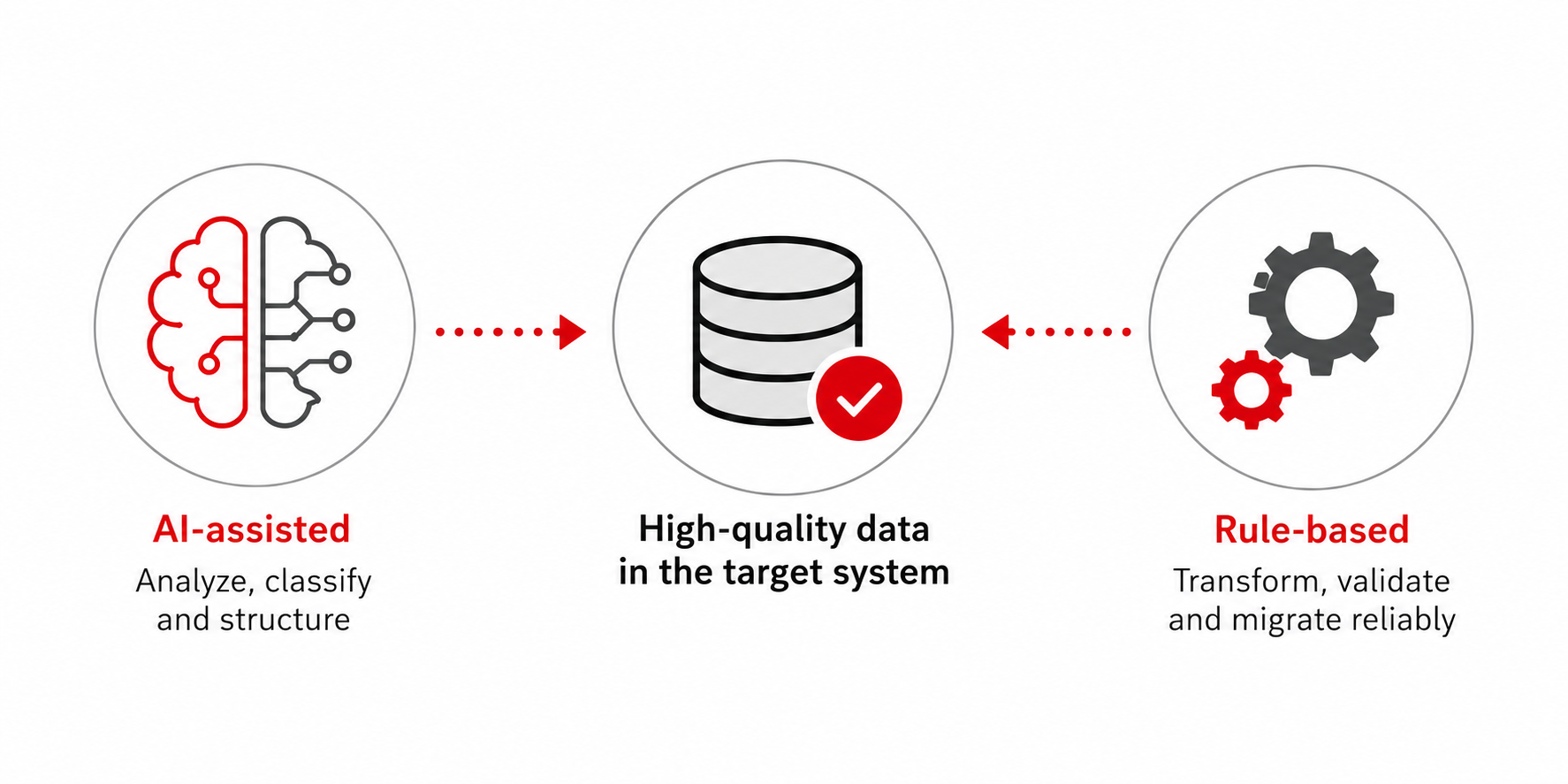
A hybrid approach combines the stability and reliability of rule-based migration with the flexibility of AI-assisted methods. This can improve data quality while reducing manual effort and shortening project timelines.
The main challenge is finding the right combination for each project. Companies need to determine which tasks can be reliably automated, where AI adds value, and which steps require expert review. The result is a migration strategy tailored to both the characteristics of the existing content and the requirements of the new information system.
Key success factors for migration projects
Whether rule-based, AI-assisted, or hybrid, choosing the right migration method is only one part of project planning. The quality of the source data, a clearly defined target architecture, and subject-matter expertise are equally important. These factors also determine which methods are suitable for specific tasks.
Four factors are particularly important for a successful data migration.
Thorough assessment of the current situation
Before migration begins, data quality, data structures, and information models should be systematically assessed. The findings help identify which content can be processed using rule-based methods and where AI-assisted approaches may offer additional benefits.
Clearly defined target architecture
Migration should always be guided by future requirements, not by the limitations of the legacy system. The target architecture defines how information must be structured, enriched with metadata, and transferred to the new system.
Defining the target architecture also involves determining the scope of the migration. Which existing content actually needs to be transferred? Is all legacy data required in the new system, or should only content that will continue to be maintained and reused be migrated?
Migration scope is a major cost driver in determining project costs.
Quality assurance
Test migrations, spot checks, and validation procedures help identify and minimize risks early on. Predefined acceptance criteria make the results measurable and verifiable.
In addition to the target structure, checks should cover completeness, links and relationships, and technical accuracy.
For AI-assisted processing steps, the model version, configuration, and results should be documented. Uncertain results must be reviewed by subject-matter experts
Subject-matter expertise
Migration projects are not purely technical undertakings. Information architecture, documentation processes, and organizational requirements must be considered from the outset.
Responsibilities for decisions and approvals, along with requirements for protecting confidential information, should be clearly defined before processing begins.
Conclusion: Treat migration as a strategic initiative, not just a technical task
Data migration is much more than a technical step in implementing a new information system. It determines whether information can continue to be found, used, and processed efficiently in the future.
The real challenge is not simply moving data from one system to another. It is preparing information so that it can be used and reused effectively in new systems and, potentially, made accessible through AI.
Rule-based migration offers stability, transparency, and control when requirements are clearly defined. AI-assisted methods can support the analysis, classification, and structuring of complex content repositories.
Which approach delivers the greatest value depends on data quality, the target structure, and the effort required for validation. In many cases, combining the two approaches is worthwhile.
That is why successful migration starts not with technical implementation, but with a thorough assessment of existing data, processes, and target structures.
Planning a data migration?
Whether you are implementing a CCMS, migrating technical documentation, carrying out a large-scale content migration, introducing a knowledge platform, or preparing for an AI project, the experts at parson AG can support you throughout the migration process. We combine technical expertise, proven methodologies, and a deep understanding of information structures.
Our services include:
- Analysis and planning: Assessing data quality, information structures, and migration effort, including a comprehensive 360-degree analysis of processes and systems
- Information architecture and system selection: Developing future-proof information architectures and content models, defining requirements, and supporting system selection and CCMS implementation
- Migration strategy and implementation: Developing suitable migration strategies and applying rule-based and AI-assisted migration methods
- AI readiness: Preparing knowledge repositories for AI-powered applications
- Quality assurance and project support: Providing structured, transparent support throughout the project, from planning to successful implementation
Our focus is not on the technology itself, but on ensuring that your information remains usable, scalable, and accessible over the long term.
Let's develop the right data migration strategy for your business