
What to expect from a modern CCMS
Eight key capabilities for connected, efficient, and AI-ready technical documentation
Chatbots answer service questions, AI systems generate content, and digital twins provide product information in real time. For all of this to work, companies need a structured and reliable knowledge base.
The key question today is therefore no longer simply: How do we create documentation? Instead, it is: How do we organize information so that it can be used across systems, reused, and made ready for AI?
Example
Anna, head of a technical documentation team at an industrial company, is facing exactly this challenge. Content is distributed across different systems, product information needs to be provided in multiple languages, and new self-service portals and AI applications are being introduced. At the same time, time pressure and product complexity continue to increase.
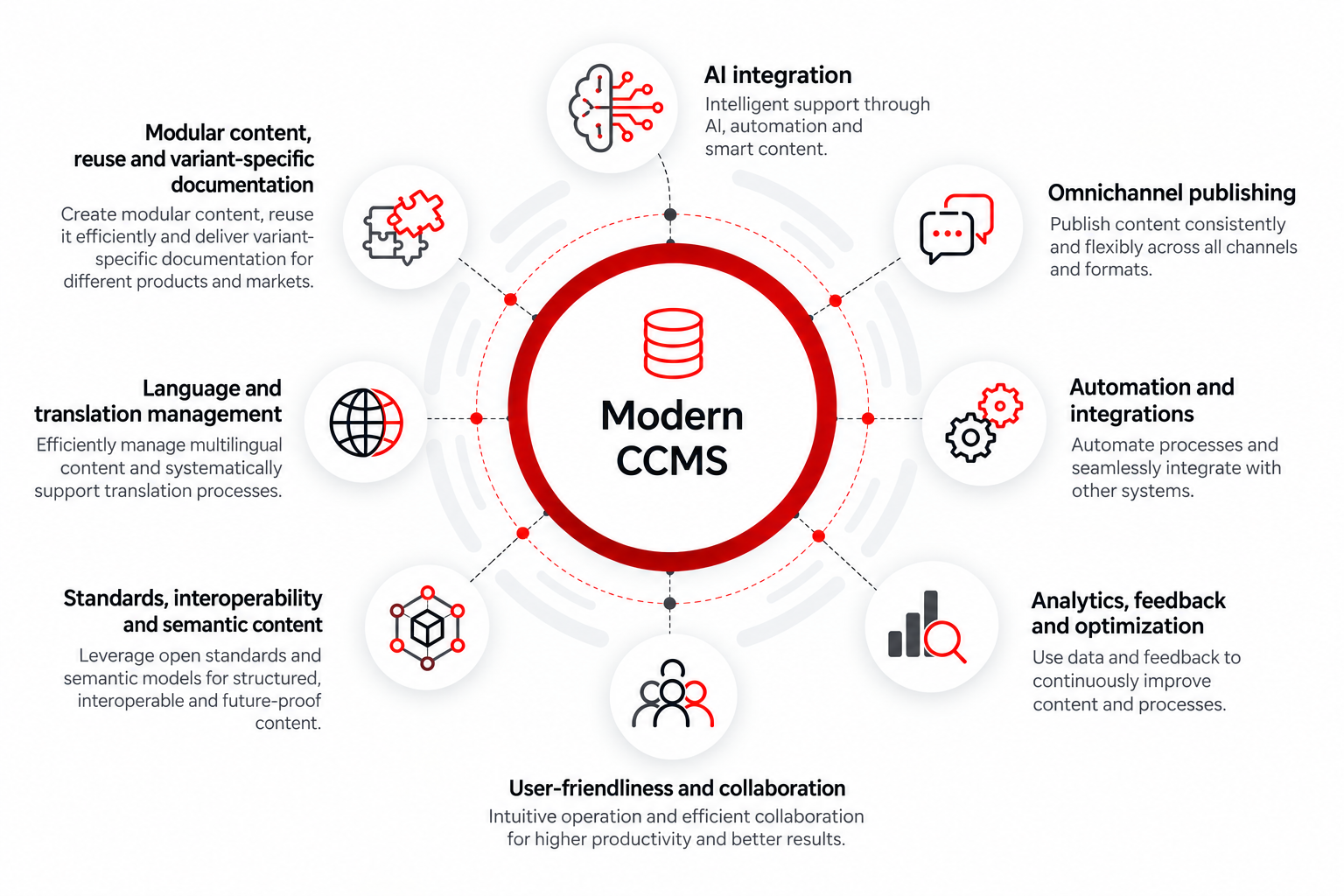
Key capabilities of a modern CCMS
Below, we look at eight key capabilities that define a modern CCMS:
- Modularity, content reuse, and variant management
- Omnichannel publishing and intelligent content delivery
- AI integration and automation
- Semantic content
- Integration and interoperability
- Governance, compliance, and secure information processes
- Usability and collaboration
- Integration into the digital data chain
(1) Modularity, content reuse, and variant management
Many technical documentation teams face this problem: The same information appears in multiple documents. As soon as something changes in a product, the search for every affected instance begins. Warnings need to be updated, technical data adjusted, or new product variants added. This takes time and increases the risk of inconsistencies.
Anna faces the same situation: Information should not have to be maintained multiple times, even when it is used in different documentation deliverables, service portals, or applications.
Modern CCMS address this challenge through single-source publishing. Instead of managing content as complete documents, they break it down into independent modules, known as topics, fragments, or snippets. A snippet might contain a warning, for example. When that warning is updated centrally, the latest version is automatically available wherever it is used.
Modularization and content reuse also provide the foundation for variant management. Content can be assigned to different product variants and used to generate documentation tailored to each variant.
Requirements
- Structured and reusable content
- Single-source publishing
- Variant management and variant-specific documentation
- Consistent information across all channels
(2) Omnichannel publishing and intelligent content delivery
Customers may search a self-service portal for maintenance information while service teams use the same content in a mobile application and an AI assistant automatically answers questions based on it. In an application or directly at a machine, customers also expect to receive exactly the information that matches their current task and context.
Scenarios like these are increasingly common. Technical information is no longer delivered through a single format or channel. Users expect content to be available exactly where they need it—quickly, up to date, and in context.
For technical documentation teams, this means that content must be flexible enough to work across different channels without requiring the same information to be maintained multiple times. When creating content, technical writers also need to consider that it may be delivered on different devices.
Modern CCMS support the delivery of both complete information products and individual information units to different channels—for example, as HTML or PDF, via an exchange format such as iiRDS, or through an interface directly to a content delivery system. This allows portals, apps, and chatbots to access up-to-date information.
Delivered content should include metadata describing the content itself, its intended use, product context, target audience, and other relevant contextual information. This enables information to be delivered according to the user's specific work situation.
A brief look at delivering content via interfaces: This type of delivery is also known as headless delivery.
Headless delivery refers to the API-based delivery of content from a CCMS in which content and presentation are separated. The CCMS manages content centrally, while portals, apps, websites, chatbots, or AI assistants retrieve the content via interfaces and handle its presentation themselves. This makes it possible to provide consistent, reusable information across channels.
Requirements
- Cross-channel content delivery
- Headless delivery
- Standardized delivery formats such as iiRDS
Would you like to assess how modular, reusable, and AI-ready your existing content is and how efficiently your information processes are set up? Learn more about our 360-degree analysis of content processes and systems.
(3) AI integration and automation in modern CCMS
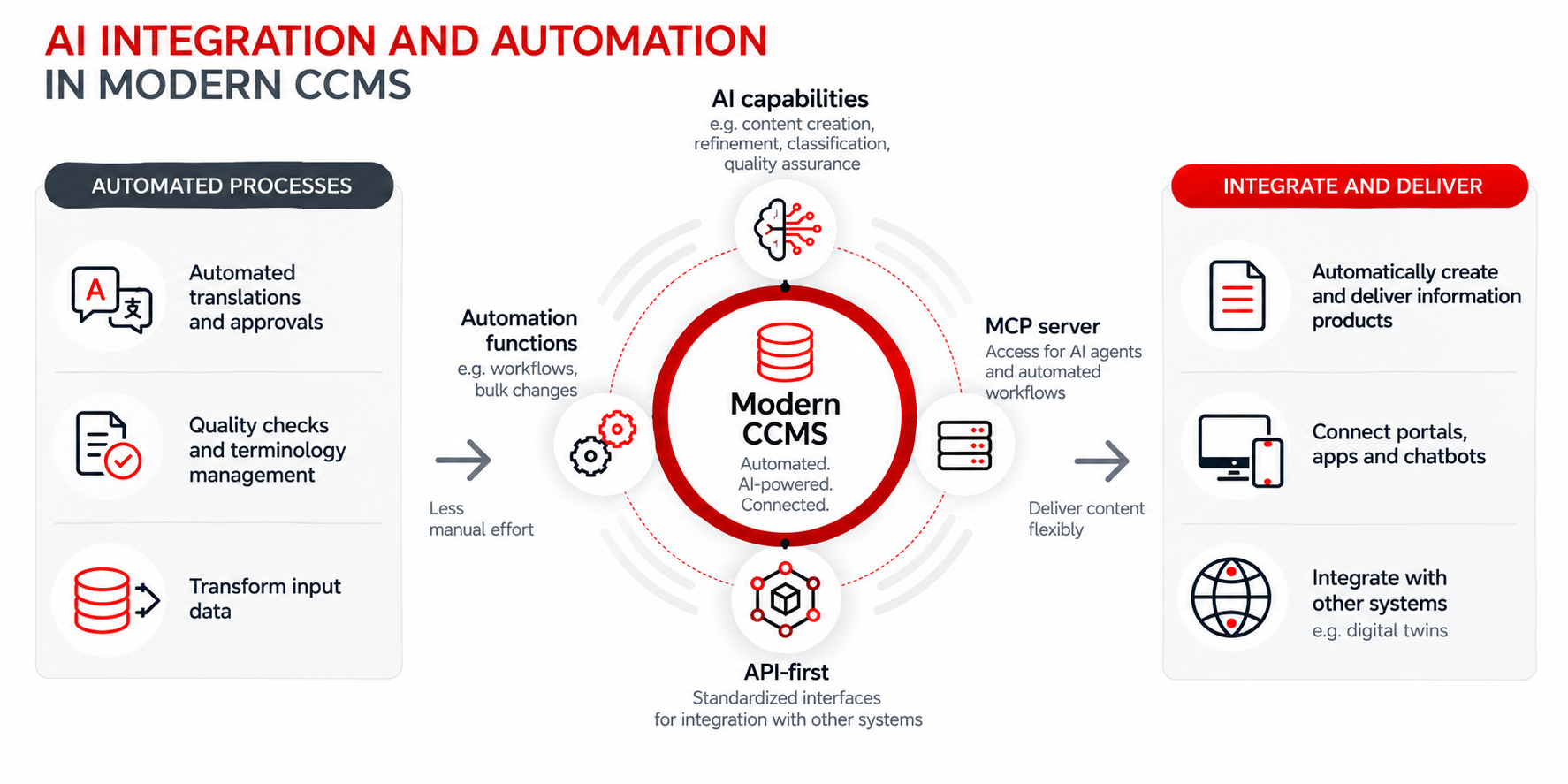
Modern CCMS are expected to do more than manage content. They should actively support and automate information processes.
For Anna, this would be crucial: Recurring tasks such as translation, approval workflows, and terminology checks should be increasingly automated, allowing the documentation team to focus on content-related work.
AI-powered features already support authors in areas such as metadata classification, quality assurance, and identifying missing information. Increasingly, CCMS are integrating generative AI directly into the authoring process—for example, by suggesting wording and potential content for reuse, revising existing content, and generating structured content. This reduces manual effort while improving consistency and reusability.
Support for the Model Context Protocol (MCP) is also becoming increasingly relevant. An MCP server can make CCMS functions available to AI agents and AI-powered workflows.
Not every efficiency gain needs to involve AI. Automating labor-intensive tasks can also make technical documentation teams more efficient. Examples include transforming input data, creating information products, making bulk changes to content, or restructuring content in response to new document definitions. A modern CCMS should provide ways to automate workflows and manage these automations.
Requirements
- Automation capabilities
- Interfaces for AI agents, for example via MCP
- AI support for content creation, content management, and quality assurance
(4) Semantic content
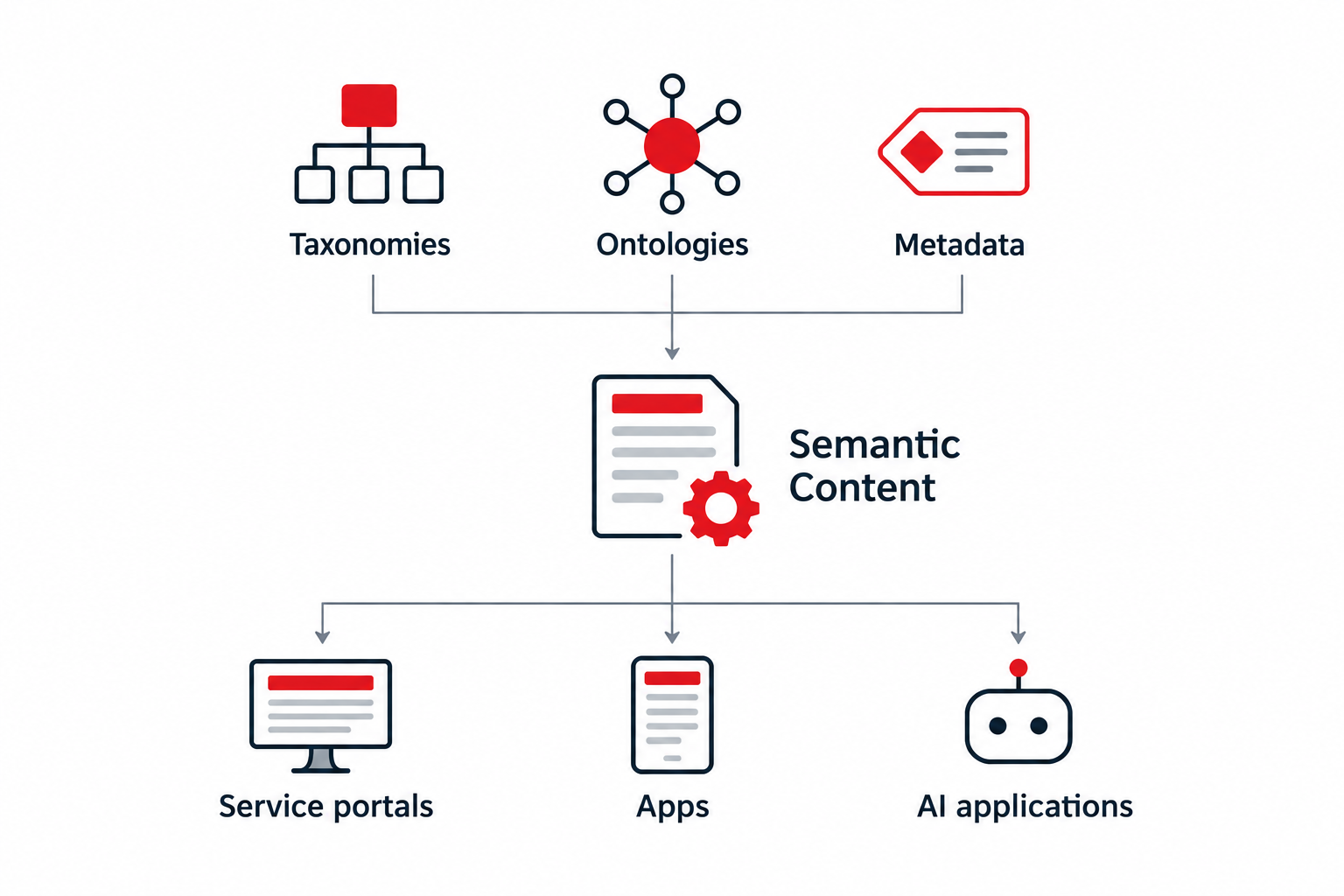
If companies want to provide technical information not only in documents but also contextually in service portals, apps, and AI applications, their content needs to be semantically enriched.
Standardized taxonomies and ontologies are becoming increasingly important for semantic enrichment. They define the types and meaning of metadata that can be assigned to content in a CCMS and included when that content is delivered as intelligent information. A CCMS must be able to integrate taxonomies and ontologies and use them to enrich content. For technical documentation, iiRDS is an important metadata standard.
Requirements
- Support for taxonomies and ontologies
- Semantic enrichment of content
We develop metadata models for technical documentation
(5) Integration and interoperability
Technical information is increasingly used across different systems and processes. A modern CCMS therefore needs to integrate into existing system landscapes and support the exchange of content and data with other systems.
Standardized interfaces are an important prerequisite.
An API-first CCMS makes its functionality available through standardized interfaces (APIs). API-first means that APIs are considered from the outset when functionality is developed. This allows CCMS functions to be accessed externally and integrated into other systems and processes.
The increasing integration of documentation content with data from leading product data management systems such as PIM or PLM can also be supported by standardized content formats such as DITA.
A CCMS should also be able to receive feedback from downstream systems so that it can be used to improve content. However, usage and feedback data are collected and analyzed outside the CCMS, for example in content delivery systems.
Requirements
- Open standards for content structures and metadata
- Integration with data from other leading systems
- Standardized interfaces and an API-first approach
- Integration and interoperability
(6) Governance, compliance, and secure information processes
As content is used across more variants, languages, and channels, approval and quality assurance processes become increasingly complex. Companies need to be able to trace who created, modified, or approved content, particularly in regulated industries.
Modern CCMS support capabilities such as versioning, audit trails, and structured approval processes. Changes are documented, and content is published only after it has passed through defined workflows.
Compliance requirements play a particularly important role in industries such as medical technology, mechanical engineering, and aerospace. Information must be consistent and traceable and provided in accordance with regulatory requirements.
Granular role and permission models, secure cloud architectures, and governance mechanisms for AI-generated content are also becoming increasingly important.
Modern CCMS should therefore do more than manage content: They should enable secure and controlled information processes.
Requirements
- Versioning and approval processes
- Role and permission models
- Secure and traceable information processes
(7) Usability and collaboration
A modern CCMS should not only be powerful but also support efficient day-to-day work. Usability plays a critical role, particularly when introducing a new system.
Modern CCMS offer intuitive interfaces, role-based dashboards, and cloud-based collaboration. Authors, reviewers, and translators see only the functions they actually need.
Because technical information is typically created collaboratively across departments and locations and with external partners, cloud-based CCMS support real-time collaboration, including comments, reviews, and approval processes.
Product information is also frequently provided in multiple languages. Language management is therefore another important capability of a modern CCMS.
Requirements
- Intuitive user interfaces
- Cloud-based collaboration
- Efficient review and approval processes
- Language management
(8) Integration into the digital data chain
While CCMS integration focuses on interfaces and data exchange, integration into the digital data chain connects documentation content with product data and product configurations.
Technical communication content is increasingly combined with data from the product domain. Product properties, technical data, and, where applicable, current measurement data determine which content variant is created and which information units are delivered to users.
In the context of the requirements arising from the Machinery Regulation and the Digital Product Passport, it is also becoming increasingly important to compile technical documentation for the specific product that has actually been delivered. In other words, companies need to provide instructions for the fully configured product variant rather than simply for the general product model.
Given the number of variants they need to cover, technical writers do not have the capacity to maintain technical data and software texts manually within the documentation. Instead, data created and maintained in other systems—such as engineering systems, PLM, PIM, or SAP—should be integrated into technical documentation automatically.
Modern CCMS therefore need mechanisms for integrating product information directly from its source systems and for controlling the generation of documentation variants based on product variants. These mechanisms may include variables and variant configurators within the CCMS. APIs connecting the CCMS to leading product data management systems are also important for this integration.
Requirements
- Standardized interfaces for integration with upstream and downstream systems
- Mechanisms for embedding data from other systems into content and controlling variants
How we can help
Read also
Which requirements matter for your organization?
Not every company needs the same capabilities. What matters depends on factors such as product diversity, translation processes, target audiences, output channels, and the level of digitalization of information processes.
Some companies primarily want to optimize content reuse, variant management, and translation processes. For others, the focus is on AI integration, digital twins, knowledge graphs, or providing information for self-service portals and chatbots.
For industrial companies like Anna's, the challenge is therefore no longer simply to introduce a new CCMS. The key question is how information can be structured, reused, and made AI-ready in the future.
The requirements that actually matter for a specific organization should be evaluated as part of a structured requirements analysis.
Read also
Would you like to find out which requirements your future CCMS should meet? parson helps companies analyze, select, and strategically develop modern content and information architectures. Schedule a consultation with our experts
Leading CCMS at a glance
A wide range of component content management systems (CCMS) are available, each with different strengths and areas of focus. Established systems include:
- Adobe Experience Manager Guides
- COSIMA (DOCUFY)
- Docuglobe and XR (gds)
- Empolis Content Lifecycle System
- madcap IXIA CCMS
- Paligo CCMS
- SCHEMA ST4 (Quanos)
- Smart Media Creator (EC Systems)
- Tridion Docs (RWS)
These systems differ in areas such as functionality, information models, integration capabilities, and technological approach. The requirements outlined in this article can serve as a basis for evaluating which CCMS best fits your organization's requirements and processes.