
The Digital Product Passport: Requirements, implementation, and scenarios for manufacturers
What companies need to know now
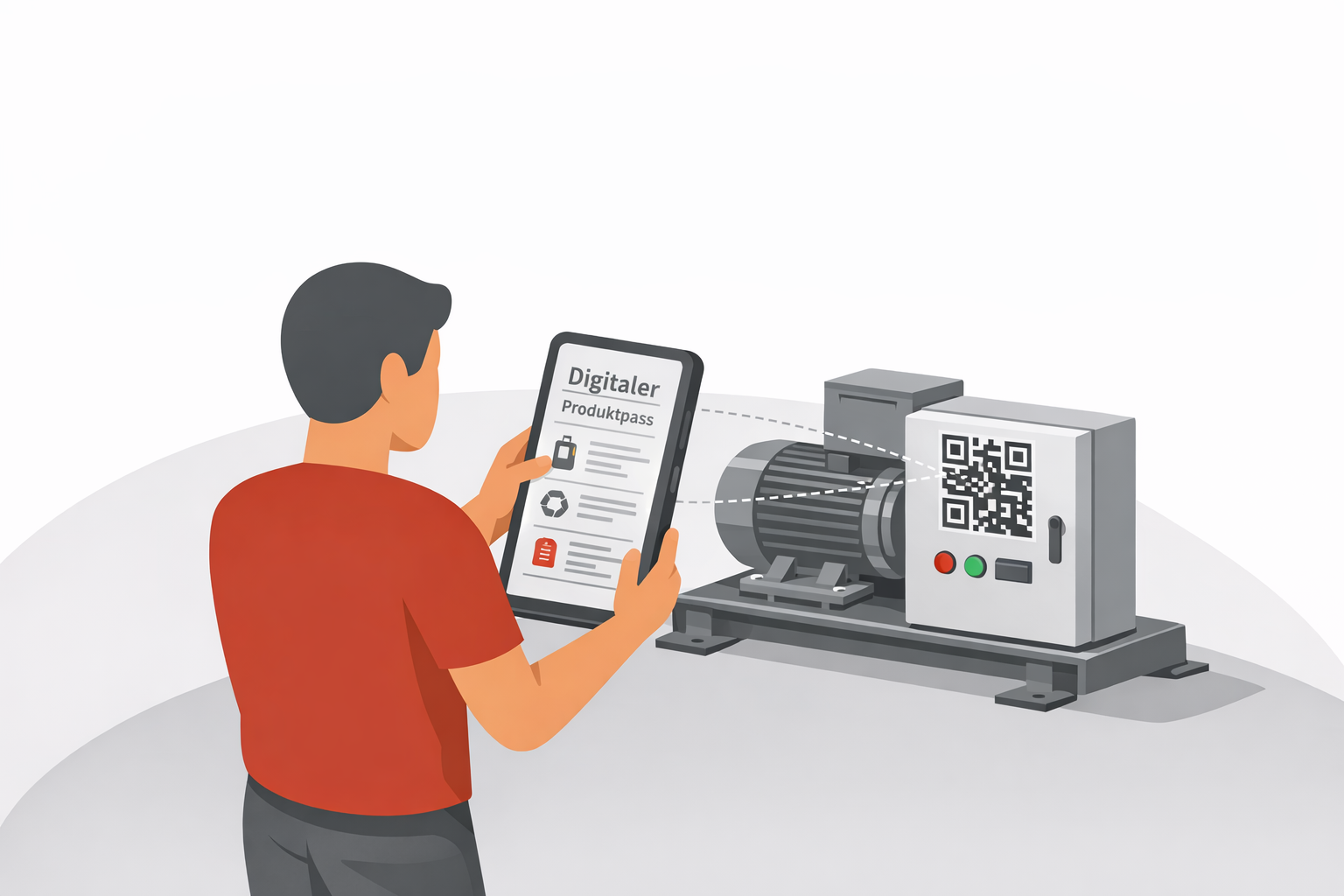
Imagine scanning a QR code on a product. You can instantly access all relevant information, including the manufacturer, technical specifications, energy consumption, maintenance intervals, and spare parts. Certificates and recyclability information are also available immediately.
This is exactly how the Digital Product Passport (DPP) works. Rather than a document, the DPP is a structured, machine-readable dataset that makes product information available throughout the entire lifecycle.
In the coming years, the DPP will gradually become mandatory for many product groups in the EU, such as batteries, electronics, and textiles. This means that manufacturers, as well as their suppliers and operators, must make product, compliance, service, and sustainability data available in a structured, machine-readable form along the supply chain via a unique identifier.
Those who start early can efficiently meet regulatory requirements and use the DPP to improve service processes, increase transparency, and develop new digital business models.
(1) What is the Digital Product Passport?
The Digital Product Passport is a structured collection of product-related data with clearly defined ownership and access rights. This means that it clearly specifies who provides, uses, and is allowed to access which data.
The scope of the data is defined per product group within the EU regulatory framework. The data can be accessed via a unique identifier, such as a QR code or NFC, and is intended to be available digitally in a decentralized manner.
Therefore, the DPP is not a single document, but rather a machine-readable dataset with a clear structure and semantics that consolidates product information across the entire product lifecycle. The DPP must function as an interoperable system. This includes the following aspects:
- Technical interoperability: The dataset must be retrievable and exchangeable via different application programming interfaces (APIs), using standardized identifiers and formats
- Syntactic and semantic interoperability: Field definitions and data logic must be standardized to ensure the consistent use of DPPs
- Organizational and legal interoperability: Responsibilities for updates and system changes must be clearly defined
The DPP is not limited to sustainability. Depending on the product group, it also includes data on compliance, safety, repair, and service. The DPP is not intended only for end customers; different stakeholders receive different views based on their legitimate interests. For example, market surveillance authorities have access to different information.
1.1 Excursus: Relationship with Digital Twin and Asset Administration Shell (AAS)
In industry, the DPP is often discussed in the context of digital twin concepts. A digital twin is a digital representation of a product throughout its lifecycle.
An appropriate approach is to implement the DPP as a regulatory use case within the AAS. The AAS is a standardized data model for describing products and their properties within a digital twin.
The "digital nameplate" (nameplate submodel) serves as an entry point to further product information. Importantly, the EU requires a technology-neutral implementation of system requirements, and the AAS is one possible option, though not the only one.
(2) Why the Digital Product Passport is being introduced
The European Ecodesign Regulation for Sustainable Products (ESPR) is the primary driver of the DPP. The ESPR establishes the framework within which product-specific requirements are gradually defined through delegated acts, i.e., detailed rules per product group.
The DPP serves as a horizontal tool for transparency, circular economy, resource conservation, and market surveillance. It may also simplify existing documentation obligations under the "New Legislative Framework."
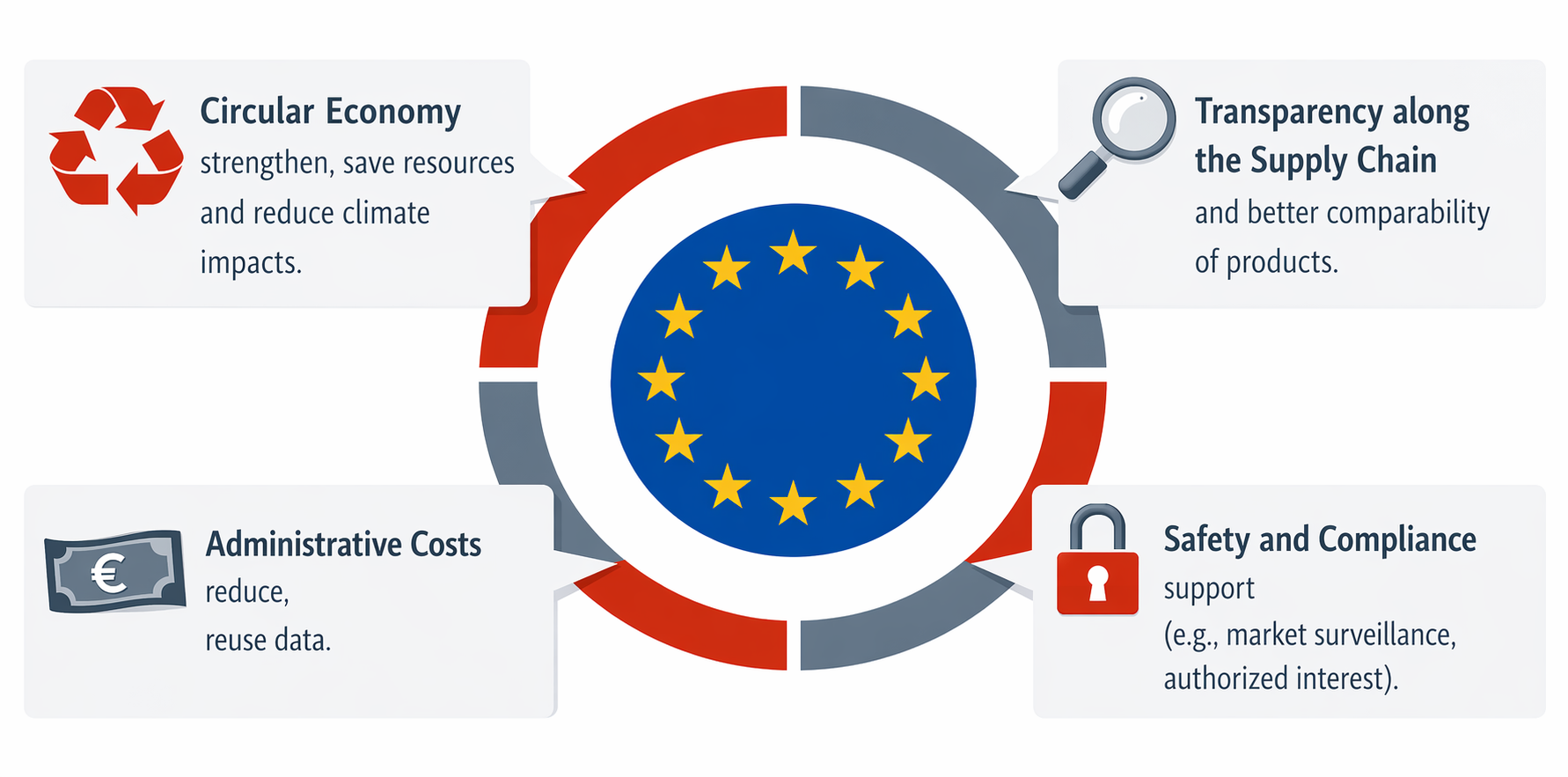
Typical objectives at the EU level include:
- Strengthening the circular economy
- Conserving resources
- Reducing climate impacts
- Increasing transparency along the supply chain and improving product comparability
- Supporting safety and compliance (e.g., market surveillance, legitimate interest)
- Reducing administrative costs and enabling data reuse (instead of providing the same information multiple times in different formats)
(3) What data is required for a Digital Product Passport?
The specific data required for a DPP varies by product group. In practice, companies need to distinguish between two levels:
(1) Mandatory DPP data that must be provided and made accessible to authorized stakeholders.
(2) Optional additional information that companies can use to improve service, support sales, or empower partners.
This means not only meeting minimum requirements, but also making existing product information strategically usable.
3.1 Example: Digital product passport for an industrial pump
A mechanical engineering company produces industrial pumps for use in plants. Such products may be subject to a Digital Product Passport under the ESPR.
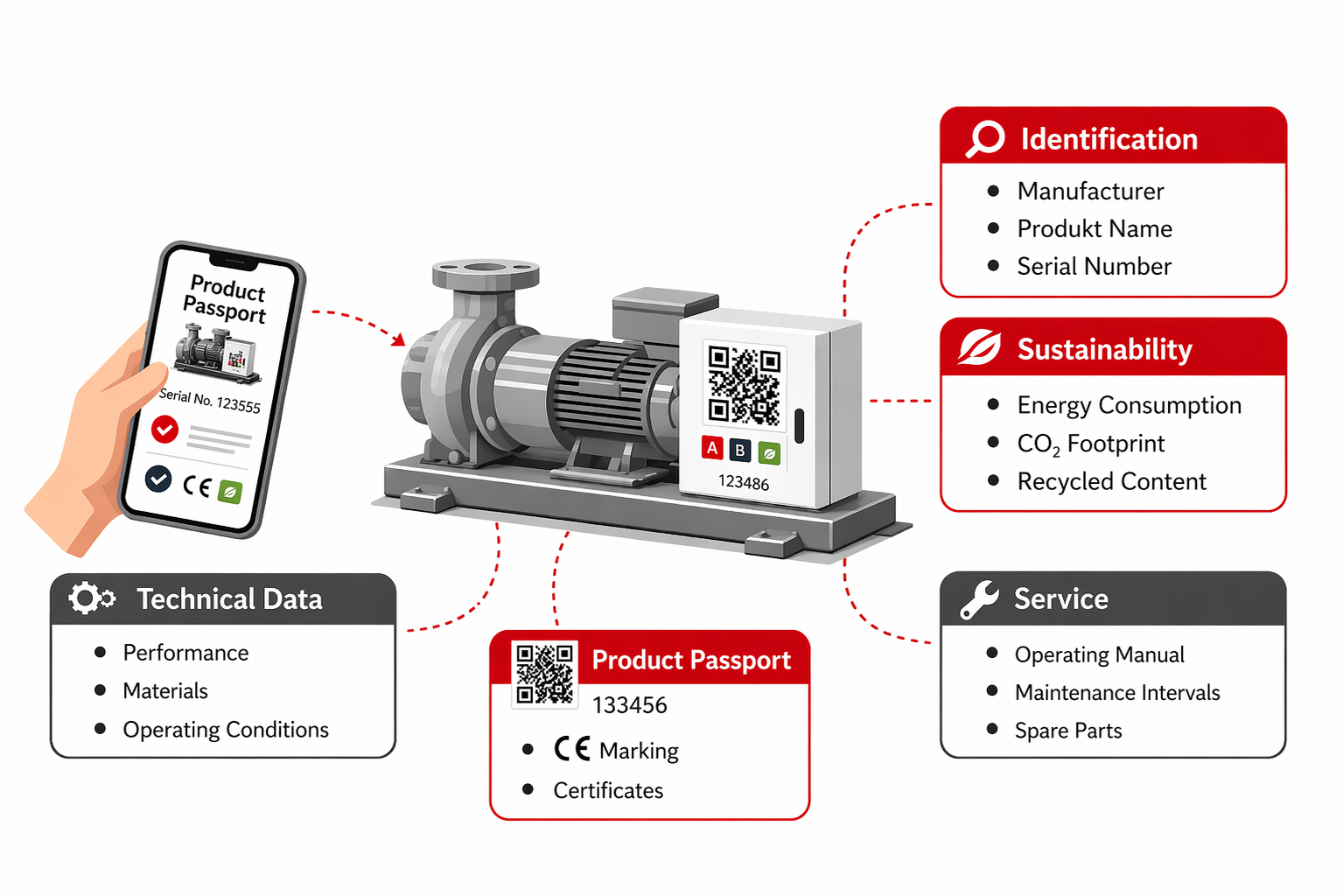
A QR code is attached to the product. When scanned, the Digital Product Passport opens and displays information, including:
- Identification: Manufacturer, product name, serial number
- Technical data: Performance, materials, permissible operating conditions
- Sustainability: Energy consumption, CO₂ footprint, recycled content
- Compliance: CE marking, certificates
- Service information and documentation: operating instructions, maintenance intervals, spare parts, repair and maintenance instructions, disposal information
This information originates from different systems and stakeholders throughout the product's lifecycle. It is then consolidated and continuously updated within the DPP.
3.2 Relevant data categories
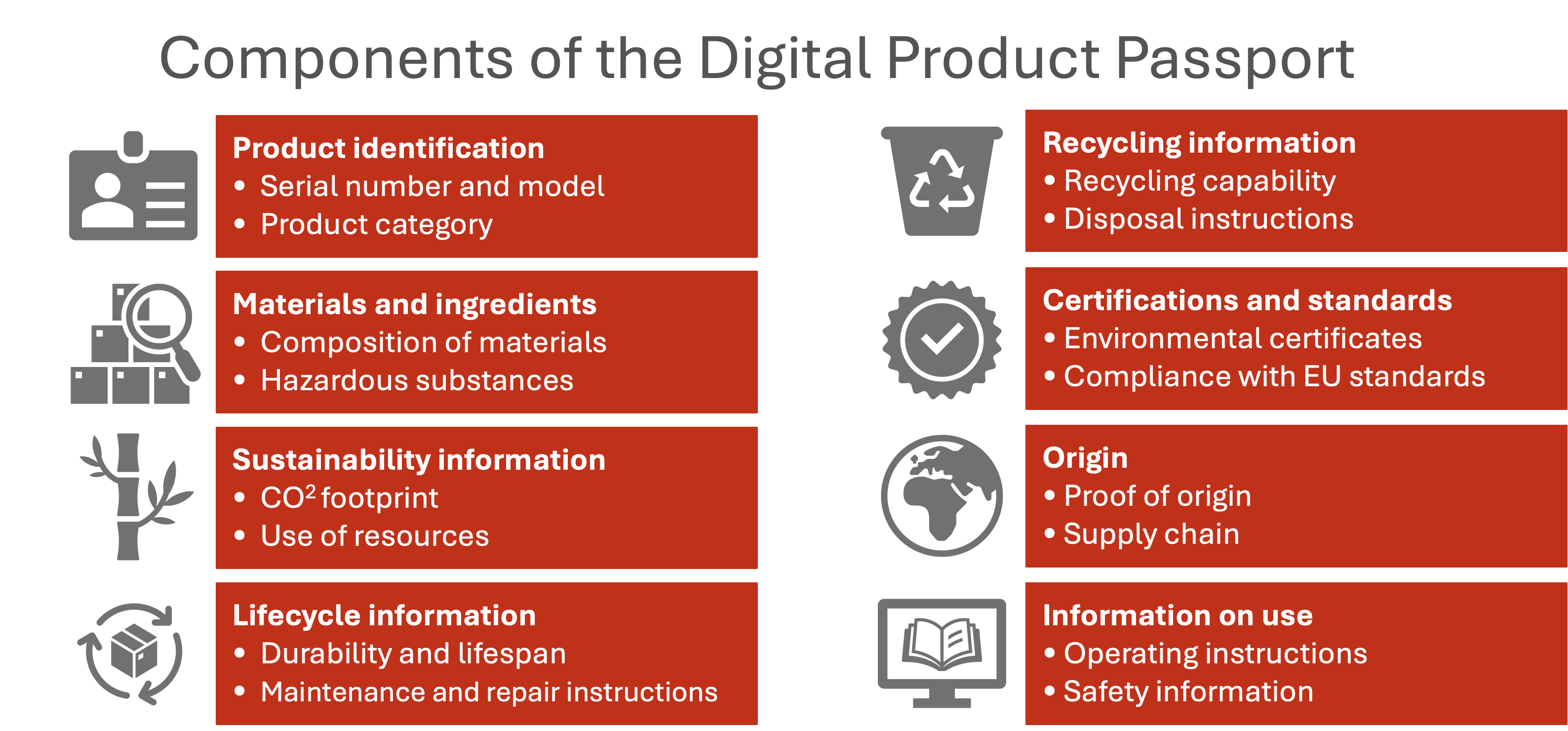
Depending on the product group, Annex III of Regulation (EU) 2024/1781² includes the following data, among others:
- Product identification: Manufacturer, product number, TARIC code, legal representative, location identifiers
- Sustainability information: Energy/material efficiency, recycled content, environmental footprint (e.g., product carbon footprint)
- Materials and substances: Material composition, substances of concern, recycled content
- Technical properties and compliance: Technical characteristics, certificates, and evidence of conformity
- Information on use, repair, and maintenance: Instructions, maintenance intervals, spare parts, repair and disassembly information
- Recycling information: Disposal guidance
The DPP consolidates information from multiple regulations and stakeholders across the entire product lifecycle. A key challenge is to consistently integrate these diverse requirements – data structures, semantics, and responsibilities – and keep them up to date.
3.3 Granularity and variants
Depending on the level, DPPs can be requested from the model level through the batch level down to the individual instance (serial number). The product passport contains more or fewer product-specific details depending on the level. The level of detail is referred to as granularity.
For companies, this raises two central implementation questions:
- How are different product variants correctly represented in the DPP?
- How are product changes represented? Spare part replacements and software updates alter the actual state of a product in the field. This may require updating the product passport, for example, when the device’s certification changes. In such cases, the DPP system must support versioning and updates.
Usage and operational data (e.g., operating hours) may also be relevant. How such data is integrated and exchanged between stakeholders is not yet fully standardized and depends on the use case.
(4) Data and systems in the DPP
The example of an industrial pump illustrates this point: The information in the Digital Product Passport does not come from a single system, but rather from various sources within the company, such as R&D, production, procurement, and service.
For the DPP to work, two elements must function together:
- the data itself, that is, the product-related content
- the system that consolidates and provides this data
The DPP data consists of the actual information in the Digital Product Passport, such as technical specifications, certificates, and maintenance instructions.
The DPP system ensures that this information:
- is consolidated from various sources
- remains up to date
- is verified and versioned
- is accessible to different users
In summary: The data describes the product. The system ensures that this data is reliably available.
The basic requirements for such a system are similar for many product groups. However, the specific data that must be included depends on the respective regulatory requirements.
4.1 Typical capabilities of a DPP system
A DPP system typically includes the following:
- Identities and data carriers (product IDs, QR/NFC, and registry integration)
- Data integrity and trust (authentication, traceability, and quality assurance)
- Data aggregation (APIs, events, ETL, mapping, and harmonization)
- Versioning and history tracking: Valid versions over time and change tracking
- Roles and access: Permissions are assigned to stakeholders, including public users, customers, service partners, market regulators, and recyclers
- Deployment: Web DPP/portal, machine-readable interfaces, export/container formats, and wallet concepts for government access, when applicable
- Operation and availability: Hosting (in-house or service provider), long-term availability, and backup/escrow concepts
4.2 Standardization of the DPP system
The EU is currently developing standards for the DPP to define how data is structured, exchanged, and made available.
Many of these requirements have not yet been finalized. They are gradually being defined as part of European standardization initiatives, such as CEN/CENELEC.
For companies, this means: The requirements will continue to evolve in the coming years. Therefore, it is advisable to design DPP systems in a flexible manner that allows for adaptation and expansion.
The following standards are planned:
| Number | Name |
|---|---|
| DIN EN 18216 | Digital Product Passport – Data exchange protocols |
| DIN EN 18219 | Digital Product Passport – Unique identifiers |
| DIN EN 18220 | Digital Product Passport – Data carriers |
| DIN EN 18221 | Digital Product Passport – Data storage, archiving and data persistence |
| DIN EN 18222 | Digital Product Passport – Application programming interfaces (APIs) for lifecycle management and searchability of the product passport |
| DIN EN 18239 | Digital Product Passport – User rights management, IT security and protection of trade secrets |
| DIN EN 18246 | Digital Product Passport – Data authentication, reliability and integrity |
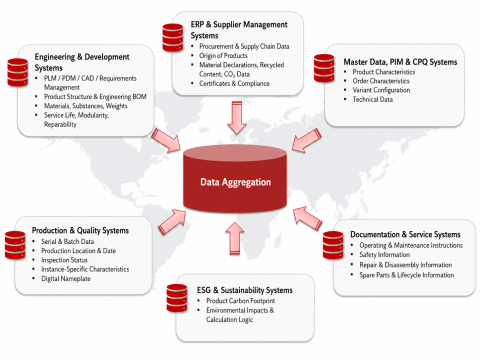
(5) Where DPP data originates
Most companies already have a wealth of information relevant to the DPP, though it is scattered across departments, systems, and formats.
The challenge lies in consolidating this data and making it consistently available. To accomplish this, companies must clarify the following:
- Which source is the primary source for which information?
- How should data be assigned to variants, versions, and instances?
- Who are the business and technical owners of the data?
Typical source systems and data inputs include:
- Engineering and development systems, such as PLM, PDM, and CAD, and requirements management:
- Product structure
- Engineering BOM
- Materials, substances, and weight
- Lifespan assumptions
- Modularity
- Repairability
- ERP and supplier management systems:
- Data on supplier procurement and the supply chain
- Product origin
- Material declarations, recycled content, CO₂ estimates
- Certificates and declarations of conformity from suppliers
- Master data management systems, PIM, and quotation systems (CPQ):
- Product features
- Order features
- Variant/configuration data
- Systems for managing production and quality, such as MES and QMS:
- Serial/batch data
- Production location and date, inspection status
- Instance-specific characteristics and digital nameplate
- Systems for managing ESG data and sustainability information
- Product carbon footprint
- Environmental impacts and verification/calculation logic
- Systems for creating and managing technical documentation, spare parts information, and service information:
- Operating/maintenance instructions, safety instructions
- Repair/disassembly information
- Spare parts and lifecycle information
The challenge is usually not a lack of data, but rather a consistent integration, structuring, and quality assurance of that data.
(6) Roles and responsibilities in the Digital Product Passport
The DPP requirement applies to more than just traditional manufacturers. Depending on the company's role in the value chain, different requirements and practical scenarios arise. The following three scenarios can help clarify the situation:
Scenario A: Your product is subject to the DPP requirement
You need a DPP system or a suitable service provider. In addition, you must:
- Provide the DPP data for your product
- Integrate relevant DPP information on supplier components
The data must be provided in the required structure and have the appropriate access rights.
Scenario B: Your product is not regulated, but it contains components that are subject to DPP requirements
In this case, the DPP information for these components must be made available in an appropriate format.
The method depends on the specific product group and regulatory requirements.
Under certain circumstances, the end product may not require its own DPP. However, customers must have access to the relevant component DPPs. For example:
- A QR code in accompanying documents
- The bill of materials
Scenario C: Your machine processes or produces regulated products
If your machine produces, modifies, or processes a product that is subject to the DPP, you may be required to provide process or sustainability data. This could include information such as:
- Materials
- Batches
- Energy and resource use
Although the product’s DPP remains with the entity that placed the product on the market, your data becomes part of the chain of evidence.
(7) How companies can get started now
Building a DPP system is a transformation initiative, not merely an IT project.
The biggest challenges are consolidating data from various sources, clearly defining responsibilities, and consistently providing information throughout the supply chain and product lifecycle.
The DPP is being introduced in phases, yet lead times can be short.
Companies that start early by structuring their data, developing a clear ID concept, and integrating their systems reduce the risk of costly, time-consuming changes later on.
At the same time, it’s worth looking beyond regulatory requirements. A well-designed DPP can accelerate service processes, create transparency, and enable new digital offerings.
If you want to set up a structured approach to the DPP in your company, we can support you by helping with the following:
- Impact analysis and scoping (product groups, roles, and the supply chain)
- Data landscape, data model, and governance setup
- Target architecture and selection/implementation of a core DPP system
- Preparation of technical documentation for machine-readable DPP use
Further reading: Circular Economy. The EU aims to transition to a circular economy for a cleaner and more competitive Europe
[1] https://eur-lex.europa.eu/legal-content/EN/TXT/?uri=CELEX%3A52025DC0187&qid=1744814743855
[2] Regulation (EU) 2024/1781 of the European Parliament and of the Council of June 13, 2024, Annex III, available at: https://eur-lex.europa.eu/legal-content/DE/TXT/?uri=CELEX:32024R1781