
parson's consulting approach to implementing modern information systems
Structured implementation of component content management systems (CCMSs), knowledge bases, customer portals, content delivery solutions, and AI systems
This article explains how organizations can use parson’s proven consulting approach to implement component content management systems (CCMSs), knowledge hubs, content delivery solutions, and other information systems in a structured, strategic way—from analyzing their current environment and defining requirements to evaluating solutions and successfully implementing the selected system.
This article is intended for organizations looking to strategically advance their information and content processes, particularly decision-makers in technical documentation, digital transformation, IT, service, and information management. It focuses on organizations with complex system landscapes that want to implement information systems using a structured, systematic approach.
Why information systems are a strategic priority today
Information systems for content management, content delivery, and data integration play a central role in making information available wherever and whenever it is needed. Users expect to access the right content in the right context—whether through a customer portal, as part of a digital service process, via a chatbot, or directly within the product itself.
As a result, organizations are no longer focused solely on implementing a component content management system (CCMS). Today, they invest in customer portals, service portals, self-service platforms, content delivery solutions, knowledge bases, knowledge hubs, and middleware that connects distributed information sources.
Selecting the right technology is only one part of a successful implementation. Equally important is ensuring that content, processes, and systems are aligned.
Related reading
- Content delivery: Technical information where it is needed
- Helping people help themselves: from manual to self-service portal
parson's consulting approach at a glance
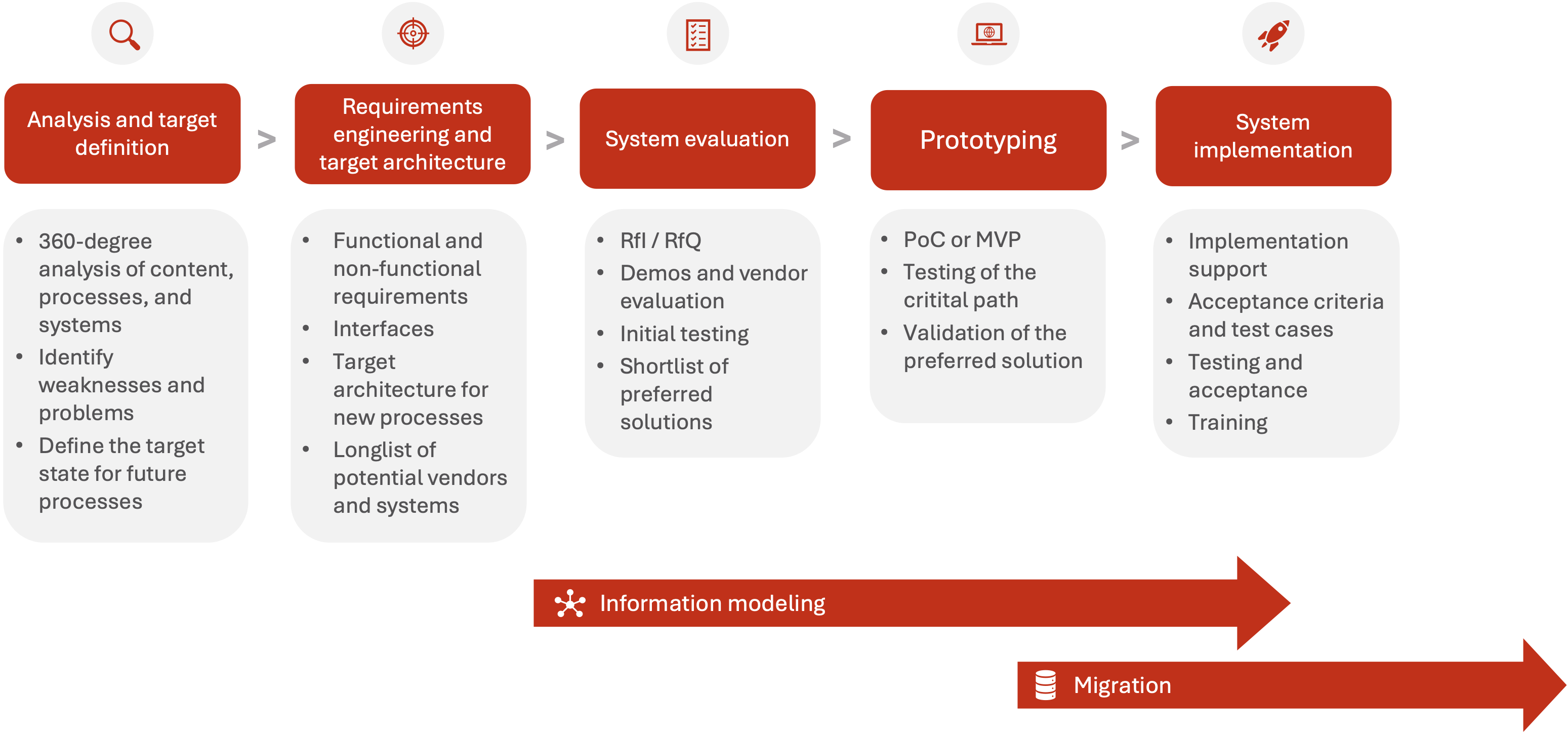
A typical parson consulting engagement consists of five core phases:
- Analysis and goal definition
- Requirements engineering and target architecture
- System evaluation
- Prototyping
- System implementation
Several cross-cutting topics also play an important role throughout the project:
- Information architecture
- Legacy content migration
- AI and automation opportunities
- Enterprise integrations
Our consulting approach is intentionally technology-agnostic. Rather than focusing on implementing a specific system, we focus on helping organizations create, manage, and deliver information efficiently across the enterprise.
This results in solutions that enable content to be managed and delivered across multiple systems and channels while remaining flexible enough to support the organization's evolving needs.
Phase 1: Analysis and goal definition
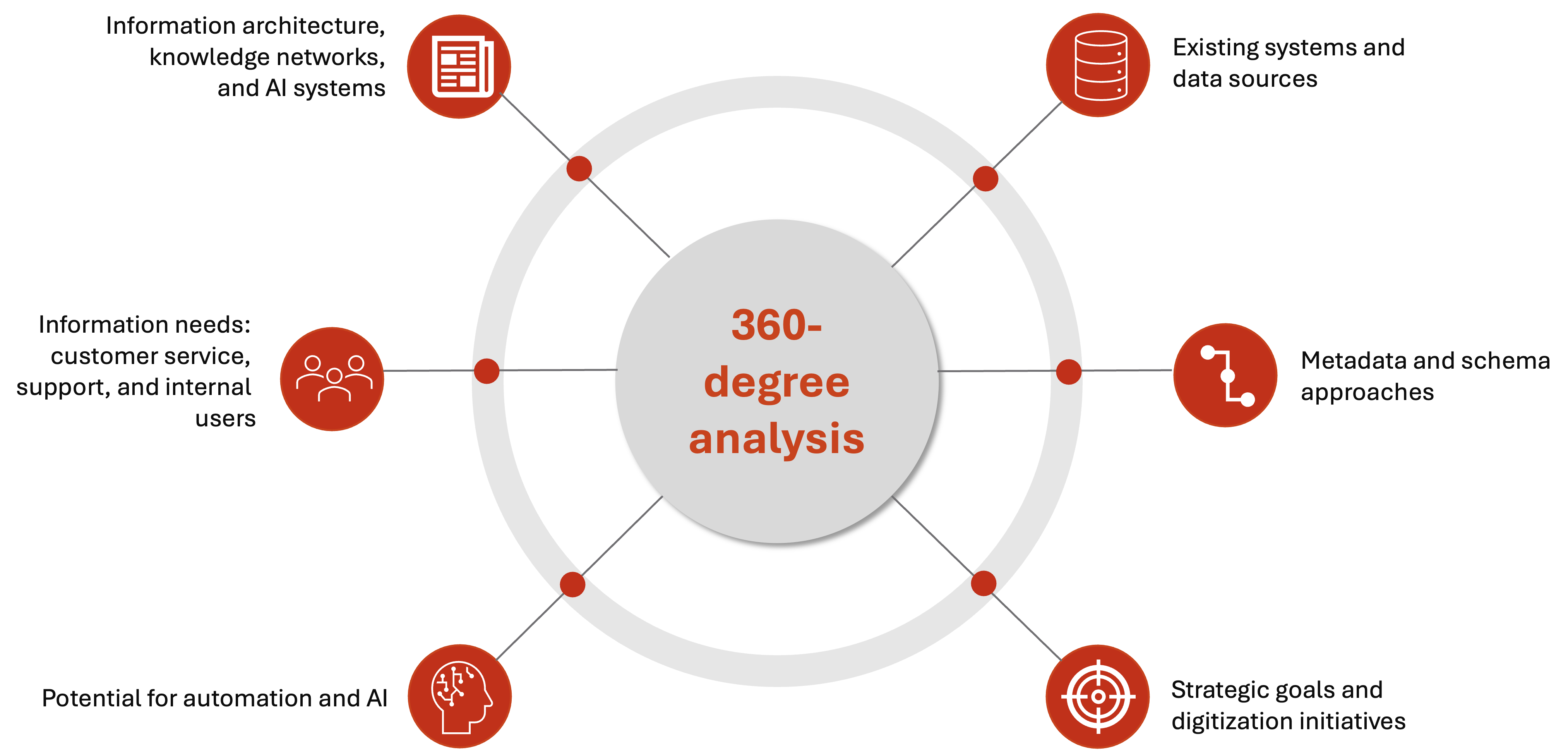
Analysis lays the foundation for a successful transformation by creating a clear understanding of the organization's existing processes, system landscape, and opportunities for improvement. Using its 360-degree analysis approach, parson examines the organization's entire information landscape, addressing questions such as:
- How is information created, managed, and shared?
- Which systems and data sources are involved?
- Where do process gaps, information silos, or other pain points exist?
- Which processes, structures, and workflows are already working well?
- What information do customers and employees need—for example, in service or support?
- Which opportunities exist for automation and AI?
- What strategic objectives is the organization pursuing, and which digital transformation initiatives are currently underway?
- How mature are the organization's content and data processes compared to industry peers?
Typical deliverables
- Overview of existing processes and systems
- Clear understanding of roles, responsibilities, and interfaces
- Analysis of information flows and process gaps
- Actionable recommendations and implementation roadmap
Learn more about analyzing content processes and system landscapes
Phase 2: Requirements engineering and target architecture
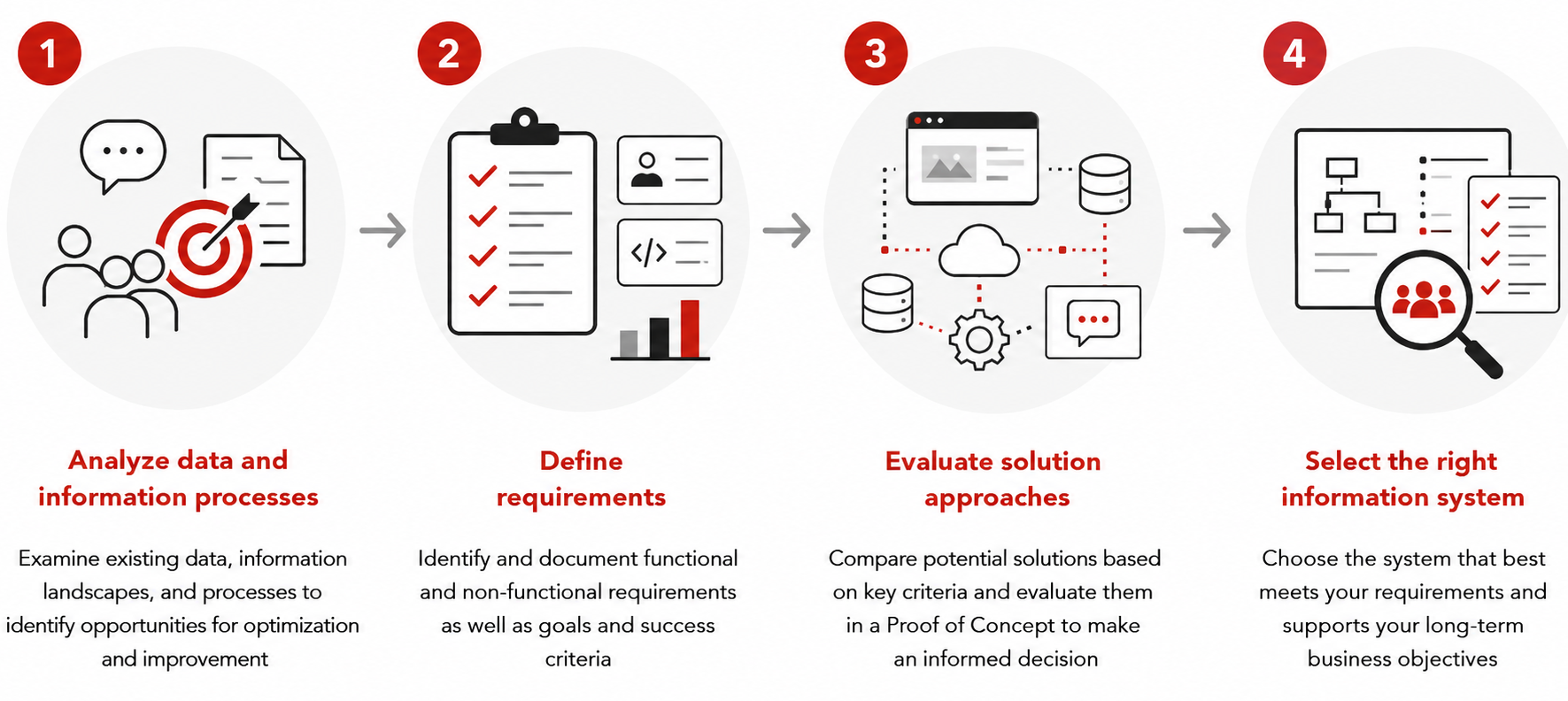
During the requirements engineering phase, strategic objectives, use cases, and organizational needs are translated into detailed business and technical requirements.
Rather than focusing on individual tools, parson considers the future system architecture as a whole – from component content management systems (CCMSs) and content delivery platforms to knowledge bases, chatbots, and middleware.
Working closely with key stakeholders, we establish a solid foundation for:
- Future information processes
- System architecture and integrations
- Digital content and data supply chains
A structured requirements engineering process provides clarity about priorities, the desired future state, and required capabilities. It also establishes the foundation for the subsequent system evaluation.
Typical deliverables
- Prioritized business and technical requirements, for example in the form of user stories
- Future-state models for information systems and processes
- Information architecture and metadata concepts
- A longlist of potential systems and vendors
Use cases
- Selecting a content delivery portal with ifm gmbh
- Analysis for a standardized information architecture with SEW-EURODRIVE
Related reading
Phase 3: System evaluation
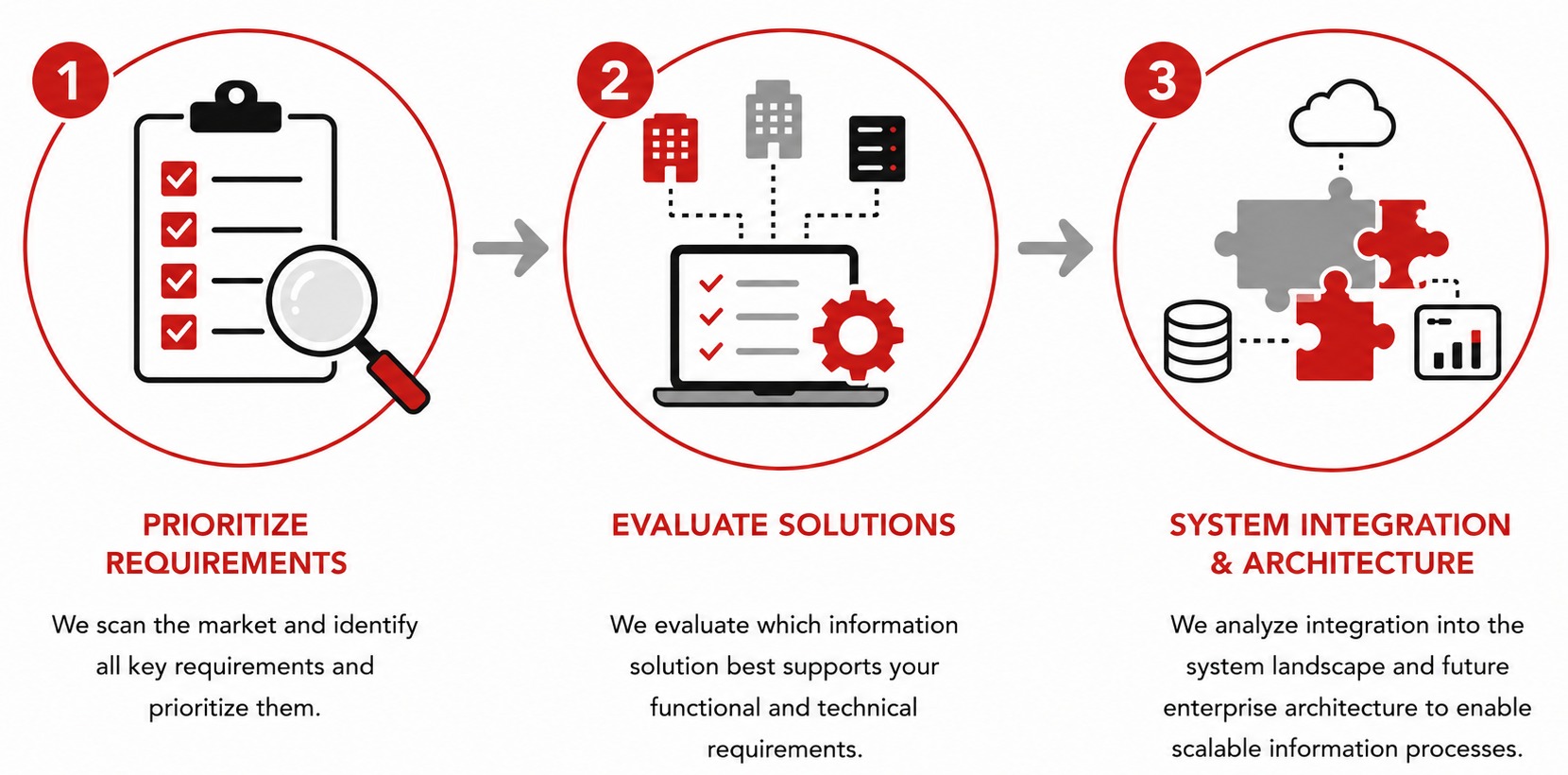
Once the requirements have been prioritized, the system evaluation phase begins. During this phase, we assess which system best meets the organization's business and technical requirements.
The system evaluation typically includes:
- Identifying and evaluating suitable platforms and vendors
- Vendor evaluations and discussions
- Requests for Information (RFIs), Requests for Quotes (RFQs), and other procurement processes
- Product demonstrations and sandbox testing
Beyond evaluating individual solutions, parson places particular emphasis on how each system fits into the existing IT landscape and the organization's future enterprise architecture. This creates the foundation for scalable, future-ready information processes.
Typical outcomes of the system evaluation
- Comparison and assessment of suitable solutions
- Shortlist of relevant vendors
- Decision-making criteria for system selection
Use case
Related reading
Learn more about implementing digital information solutions.
Phase 4: Prototyping
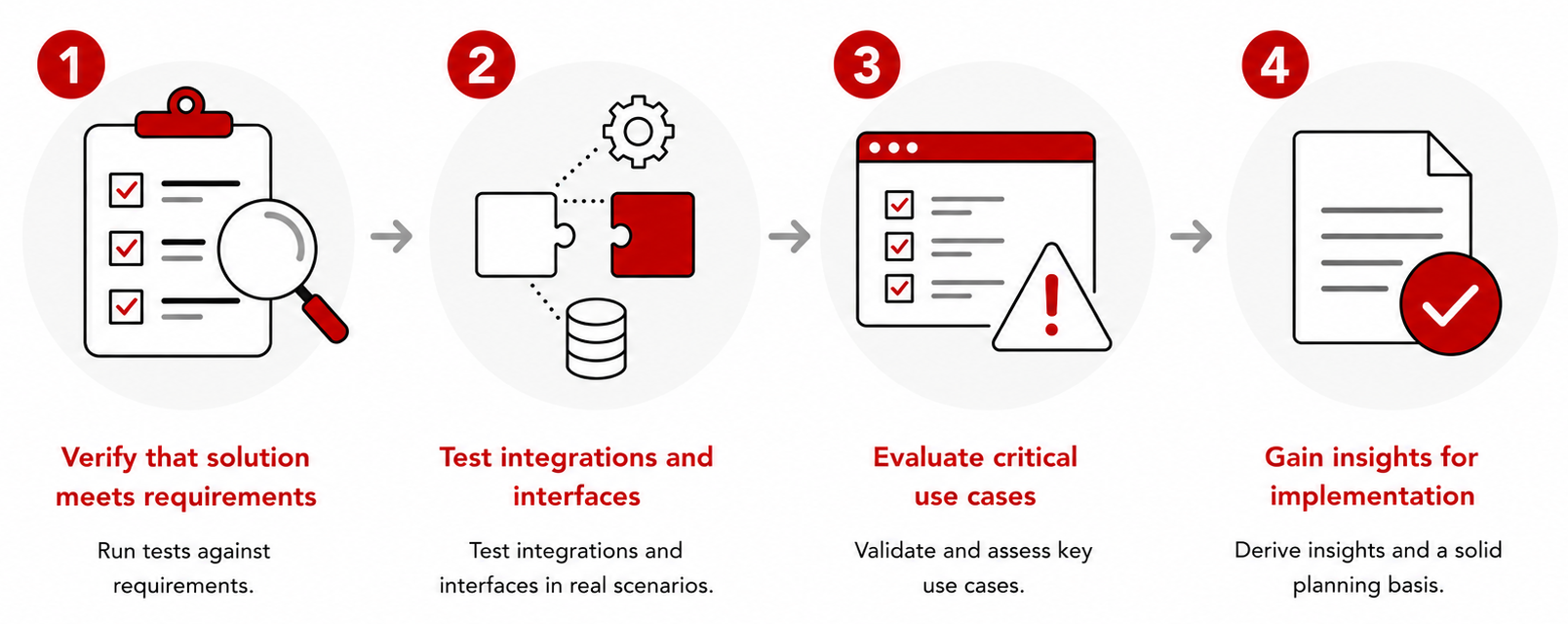
During the prototyping phase, we validate how well the selected solution performs under realistic conditions.
This is often done as part of a proof of concept (PoC) or a minimum viable product (MVP). Real-world use cases, integrations, information models, and business processes are tested to determine whether the proposed solution meets the organization's requirements.
The goal is to identify risks early and validate key assumptions before implementation begins.
Typical deliverables
- Validation results against the defined requirements
- Findings on integrations and interfaces
- Assessment of critical use cases
- Recommendations and planning guidance for the implementation phase
Phase 5: System implementation
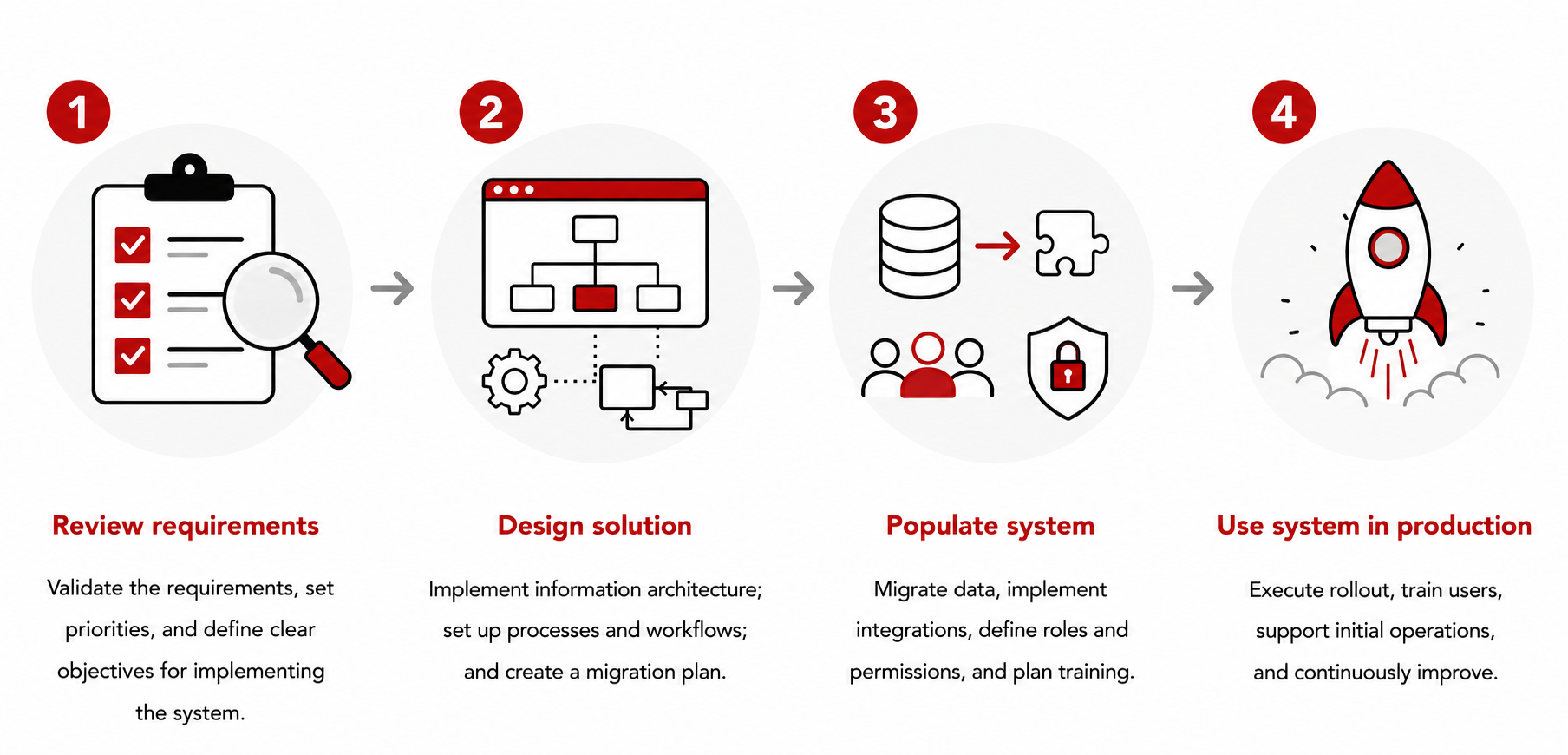
During the implementation phase, parson works closely with software vendors and implementation partners to deploy the selected information system.
The focus extends beyond technical implementation to include organizational change and the adoption of new ways of working.
Key activities during this phase
- Implementing the information architecture
- Integrating existing systems
- Migrating legacy content and data
- Establishing new processes and workflows
- Change management
- Training and enablement
The goal is not simply to deploy a new system, but to establish sustainable, future-ready information processes across the organization.
Typical deliverables
- Production-ready information system
- Implemented information architecture
- Migrated content and data
- Trained teams and established ways of working
- Established processes and workflows
Use cases
- Endress+Hauser: Automated, configuration-specific documentation
- From classic documents to smart content and modern content delivery with GS1
Learn more about implementing component content management systems and digital information solutions
Why a structured approach matters
Implementing digital information systems typically affects multiple business processes, systems, and departments at the same time. Without a clear vision, well-defined requirements, and a structured decision-making framework, organizations often face integration challenges, costly content migrations, or poor technology choices.
parson's structured consulting approach helps organizations identify risks early, make informed decisions, and implement projects in a systematic, predictable way.
Our consulting principles
When implementing digital information systems, parson follows a structured, vendor-neutral, and practical consulting approach. We view the implementation of information systems not as an isolated software project, but as a core element of a broader digital information, data, and content strategy.
We place particular emphasis on transparent decision-making, structured risk management, and close collaboration with our clients' project teams. Together with business stakeholders, we design future-ready information architectures that connect processes, systems, and content in a meaningful way. By combining proven methodologies with agile ways of working, we help ensure that projects remain both adaptable and predictable.
Conclusion
Implementing an information system today is about far more than deploying new software. parson's structured consulting approach provides a solid foundation for success—from the initial analysis through production rollout.
This results in scalable, integrated, and future-ready information processes that enable organizations to manage and deliver information more effectively over the long term.
FAQ – Frequently Asked Questions
How long does it typically take to implement a new information system?
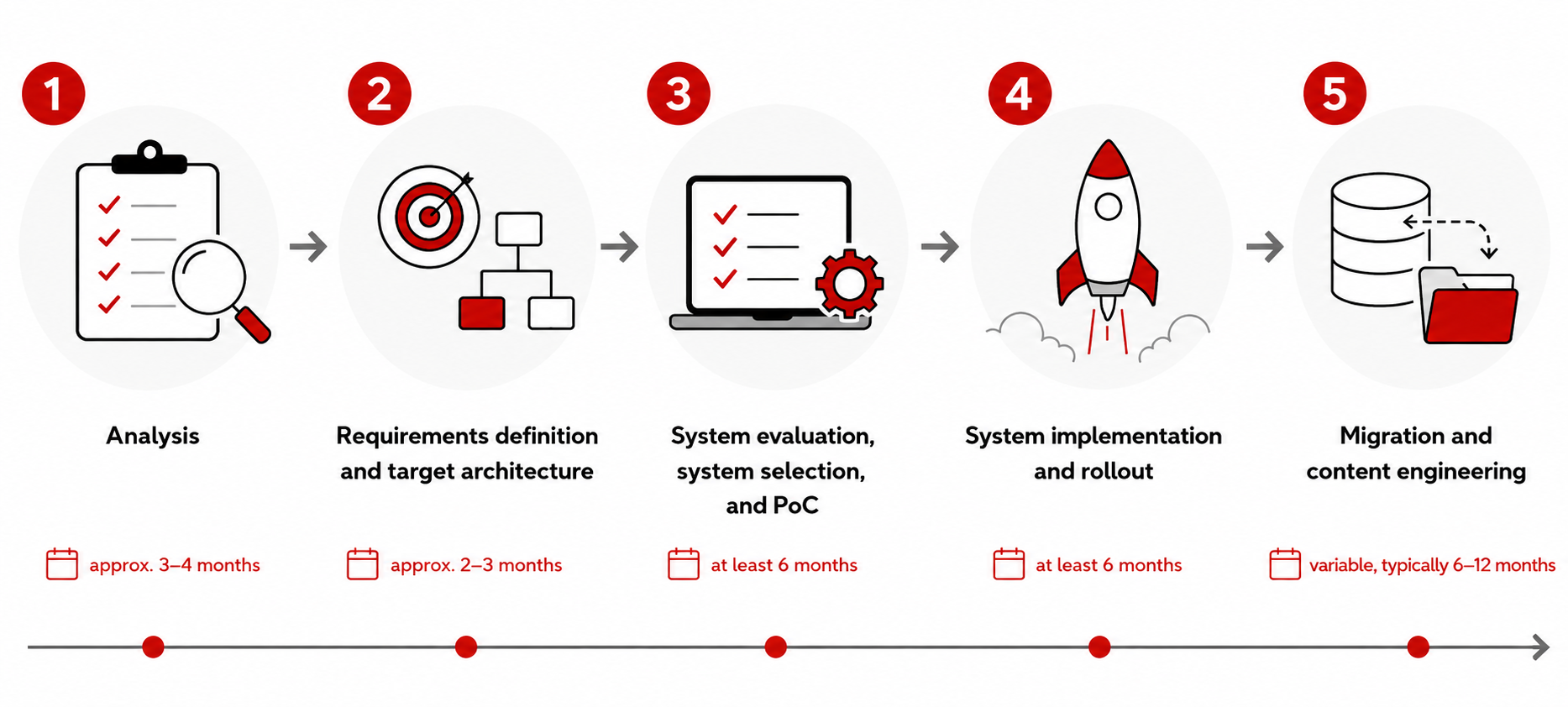
The timeline for implementing a new information system depends on the project's scope, the complexity of the existing system landscape, and the chosen migration strategy. The following timeline represents a typical "happy path" for implementing a new information system or component content management system (CCMS):
- Analysis: approximately 3–4 months
- Requirements engineering and future-state architecture: approximately 2–3 months
- System evaluation, system selection, and proof of concept (PoC): at least 6 months
- System implementation and rollout: at least 6 months
- Migration and content engineering: variable, typically 6–12 months
Information modeling and content migration can often be carried out in parallel with other project phases. The overall effort and timeline depend largely on the scope and quality of the existing documentation.
For this reason, many organizations adopt an iterative approach, starting with pilot projects, individual product lines, or phased rollouts.
Does every information system implementation project need to include all five phases?
Not necessarily. The scope and depth of each phase in parson's consulting approach depend on the organization's starting point. Companies with a well-defined future-state architecture or clearly documented requirements may be able to shorten or streamline certain work packages.
However, for complex transformation initiatives, we generally recommend addressing all five phases to minimize project risk and avoid costly issues later in the implementation.
When is a proof of concept necessary when implementing an information system such as a component content management system or content delivery solution?
A proof of concept (PoC) is particularly valuable when a project involves complex integrations, new technologies, or business-critical processes. For smaller projects with well-defined requirements, the system evaluation may already provide sufficient information to make a confident technology decision.
When project timelines are especially tight, it may also be appropriate to skip the prototyping phase.
What role does AI play in implementing an information system?
At parson, we view AI as an integral part of future information processes rather than as a stand-alone technology. During the analysis and requirements definition phases, organizations can already evaluate potential AI use cases for knowledge delivery, data processing, content creation, self-service, and intelligent assistance.
When should content migration be planned when implementing a new component content management system?
Migration planning should begin early in the project. The volume, quality, and structure of existing content often have a significant impact on the project's scope, timeline, and implementation strategy.