
How parson is developing an AI-ready content strategy with Buildwise
Sometimes a project starts by searching for a system – and leads to a whole new perspective on content, processes, and requirements.
Buildwise has been actively exploring how technical information can be made usable for AI applications. The goal is clear: Content needs to be prepared in a way that provides a solid foundation for modern AI applications and intelligent information systems. This requires a future-ready system landscape.
Buildwise is Belgium’s innovation center for the construction sector. It develops practical solutions and provides technical information to around 120,000 construction companies and other professionals (designers, architects, manufacturers, …).
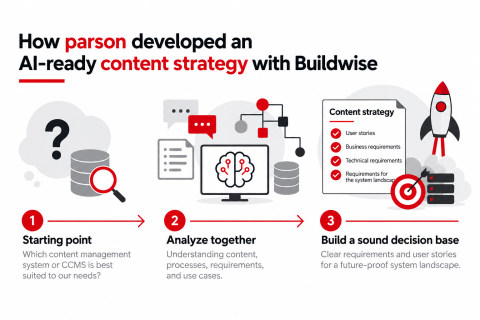
As AI requirements continued to evolve, one question became increasingly important: How can technical information be provided in a way that works equally well for people and intelligent systems? One of the initial questions was: Which content management system or component content management system (CCMS) would be best suited to this?
Early in the project it became clear that making a well-founded system decision first required a shared understanding of the requirements – and that these requirements extended far beyond the selection of a CCMS.
„It soon became about much more than a CCMS“

We wanted to prepare our technical information for future AI applications. Finding a suitable CCMS was an important starting point – but it wasn’t the ultimate goal. What mattered to us was creating the right foundation for future AI-enabled information systems.
Building the foundations together

Buildwise had a clear vision for the future: information should be provided in a way that supports both people and AI applications effectively over the long term. Together, we identified the content-related, organizational, and technological foundations needed to make that vision a reality.
Rather than immediately evaluating different systems, the project team first analyzed the existing information landscape. Through stakeholder interviews, the team examined content, information flows, processes, and potential use cases. Step by step, this created a shared understanding of how systems, content, and processes currently interact – and what this means for future requirements.
„The outside perspective broadened our view“
The interviews with the parson experts helped us define our requirements much more precisely. They showed us that topics such as the system landscape, metadata, and content structures are just as important as the eventual selection of a CCMS.
As the project progressed, an increasingly clear picture of the existing content landscape emerged. Different information sources, heterogeneous processes, and a lack of shared metadata made it difficult not only to reuse information, but also to make it available to AI applications. At the same time, it became clear just how closely content, processes, and the existing system landscape are interconnected.
The real challenge was not the absence of a particular system, but the question of how to structure and describe information consistently across systems.
From a system question to a content strategy
Selecting the right system is important. But it only makes sense in the long term once the broader requirements are clear and there is a shared understanding of how content will be provided and used by AI applications in the future.
What had originally been planned as a system evaluation gradually evolved into a structured definition of requirements.
As the project progressed, the requirements were developed collaboratively and documented as user stories. Today, these user stories provide the basis for further developing the system landscape and making informed technology decisions.
„Today, we have a much stronger basis for decision-making“
For me, the greatest value of the project is that we can now describe our requirements much more clearly. This allows us to evaluate new technologies more effectively and plan our next steps in a much more targeted way.
„Consulting means broadening the perspective together“
Our task wasn’t to recommend a tool as quickly as possible. Together with Buildwise, we first wanted to understand which information already exists, how it is created, and which requirements arise from the planned use cases. That provides a solid foundation for every decision that follows.
The result
What began as a CCMS evaluation developed into a strategic project to define the requirements for Buildwise’s future system architecture.
Together, we achieved the following:
- Analysis of the existing information landscape
- Identification of stakeholder requirements
- Development of user stories
- Structured definition of content-related and technical requirements
- Definition of requirements for the future system landscape
- Creation of a sound basis for selecting future content systems
Conclusion
The project showed us that successful AI projects don’t start with technology. They start with a shared understanding of information, processes, and requirements. That foundation now enables us to make upcoming technology decisions with much greater confidence.
The Buildwise success story demonstrates that organizations looking to make their information usable for AI should not start by selecting a technology. They should start by developing a clear understanding of their own requirements and processes. That was the key to the success of this project.
About Buildwise
Buildwise is a private innovation institute founded in 1959 under impulse of the National Federation of Belgian Building Contractors. The statutory members of Buildwise are the more than 120,000 Belgian construction companies, mostly SMEs.
According to its statutes, Buildwise has the following three main tasks:
* to perform scientific and technical research for the benefit of its members
* to supply technical information, assistance and advice to its members
* to contribute to the general innovation and development in the construction sector
To fulfill these tasks, Buildwise pools on the expertise of more than 320 highly skilled and motivated staff members working in multidisciplinary teams.